Okay, technically it leads to the new Vikings stadium, but Nick Magrino doubts its benefits justify $6 million of public spending. A proportion of the Metropolitan Council is inclined to agree.



Nick Magrino argues that the $6 million pedestrian bridge connecting a light rail station to the Vikings stadium just isn't worth it. Normal operating procedures (without the bridge) might involve temporary road closures, but would require fans to cross the street. Magrino asks, "is preventing thousands of Vikings fans from touching a Minneapolis street worth the cost of this pedestrian bridge?"
Not only is the project's very necessity in question; it is also one of the more expensive such bridges conceived.
From the article: "Alternatively, 1,000 bus shelters could be purchased, or perhaps 100 heated bus shelters. Or, if we were averse to spending money on buses for fear our constituents would not use them, we could put $6 million towards converting Downtown East Station to a center island station, so that people transferring betwixt the Blue and Green Lines would not need to walk across the tracks."
Read the full story: This unnecessary pedestrian bridge is going to cost $6 million of public money

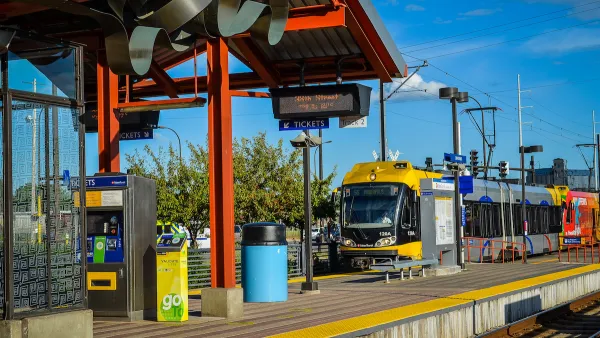
Twin Cities Trains Move to Fewer Cars, Higher Frequency
Headways will drop from 15 minutes to 12 minutes.
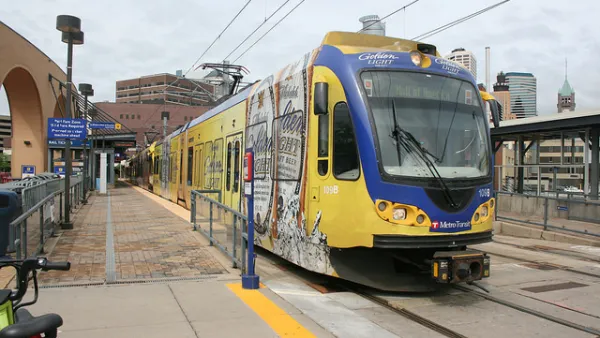
Blue Line Extension North of Minneapolis in Jeopardy
A planned extension of the Metro Blue Line north from Minneapolis depended on eight miles of BNSF track.
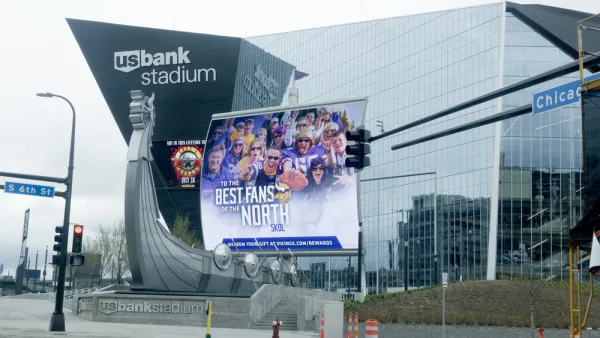
Inside the 2018 Super Bowl's 'Luxified' Venue
When the Eagles and the Patriots face off this weekend, they'll do it at Minneapolis' U.S. Bank Stadium, a billion-dollar venue that "aspires to more than football."

Planetizen Federal Action Tracker
A weekly monitor of how Trump’s orders and actions are impacting planners and planning in America.

California plans to bury El Niño’s downpour
If the state plays its cards right, it may be able to store a billion acre-feet of El Niño’s water in aquifers.

Chicago breaks ground on $3 billion megadevelopment
The new neighborhood, titled Foundry Park, will one day host 3,700 residences.

California High-Speed Rail Authority CEO resigns after $600,000 scandal
Under Ian Choudri, the authority used taxpayer dollars to fund first class flights and trips to nightclubs.

Want to study the Missouri River? Soon, you may need unanimous approval from 10 states
Legislation would require 10 governors’ permission to study or build projects moving water outside the basin.

Desperate measures: Advocates weigh draining Lake Powell to fill Colorado River
Draining the reservoir could reduce evaporation losses by a couple hundred thousand acre-feet.

FREE Course: Walkable City 1: Why Walkability?
After describing his path towards focusing on walkability as the essence of good planning, Jeff Speck marches through his five principal reasons for making more walkable places.
Reinventing Malls: Planning Alchemy—Turning Gray Fields Into Gold
The course focuses on the opportunities and imperatives that shape reinvention of mall sites.

City of Rosemead
Rutgers University, Edward J. Bloustein School of Planning and Public Policy
One Hundred Miles
Hunter College, City University of New York (CUNY)
The Architects Foundation
University of Cincinnati Online
City of Cambridge
Montrose County
The Pocatello Development Authority