The U.S. Department of Transportation has changed its rules in favor of local hiring: a pilot program will even encourage it. Minorities traditionally barred from high-paying construction work stand to benefit.


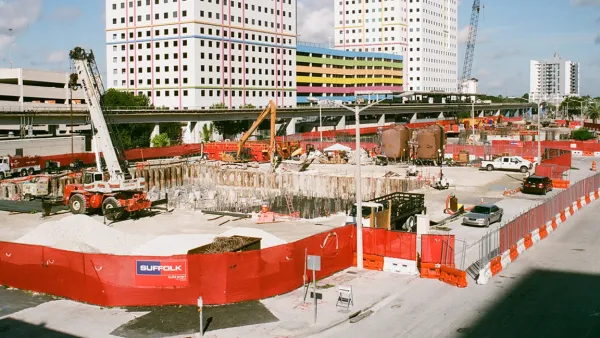
A recent Justice Department ruling has prompted the U.S. Department of Transportation to "change its own rules to permit local projects receiving federal assistance to use local preferences in hiring employees. At the same time, the department is launching a one-year 'hire local' pilot program to encourage transportation agencies to set up programs that give preference in hiring to local residents, low-income workers and veterans."
Not everyone is sold. Sandy Smith writes that the construction trade's union-centric culture has been slow to incorporate certain kinds of people. "One other obstacle the advocates said needed to be overcome is the reluctance of some in the construction trades to recognize the untapped value in this potential workforce. Some contractors and union officials worry that there won't be enough qualified candidates in low-income communities, for instance."
The rule change may begin to change that perception, garnering real benefits for minority communities: "construction remains one of a relative handful of fields that offer the opportunity for high-paying skilled work to those without college degrees."
The public has until May 6 to comment on the proposed change.
FULL STORY: DOT Rule Change Lets Transportation Dollars Stay in Local Communities

Trump Administration Kills Obama Era Local Hiring Program
The U.S. Department of Transportation quietly killed an Obama Administration program that would have been the only federal level local hiring initiative.
Boston Working to Keep Construction Hiring Local and Diverse
The city of Boston is working to ensure that a diverse collection of residents are benefitting from the fruits of the city's current building boom.
Competing Land Use Initiatives on the November Ballot in Los Angeles
Move over "Neighborhood Integrity Initiative." The "Build Better LA" initiative will compete for the soul of the city in the November election.

Planetizen Federal Action Tracker
A weekly monitor of how Trump’s orders and actions are impacting planners and planning in America.

The state-sanctioned urbicide of Austin
People don’t kill cities. Freeways do.

US to reduce Colorado River water deliveries to Mexico
A new Colorado Treaty amendment reduces Mexico’s Colorado River water allocation by 250,000 acre feet.

5 New England states march closer to 800 megawatt wind energy project
Securing federal approval for the project may be complicated under the Trump administration, which has historically been hostile towards domestic wind power.

Baltimore to break ground on $50 million Transit Priority Project
The project will bring faster bus trips, safer streets and better bike connections to Baltimore.

Airbnb launches $250 million 'last-dollar financing' housing accelerator, makes first investment in Austin
The company will put $6.4 million towards affordable housing development in Texas’ capital.

FREE Course: Walkable City 1: Why Walkability?
After describing his path towards focusing on walkability as the essence of good planning, Jeff Speck marches through his five principal reasons for making more walkable places.
Reinventing Malls: Planning Alchemy—Turning Gray Fields Into Gold
The course focuses on the opportunities and imperatives that shape reinvention of mall sites.

Eagle County Government
Harvard University Graduate School of Design
Nashville Planning Department
The Architects Foundation
University of Cincinnati Online
The Pocatello Development Authority
The Urban Renewal Agency of the City of Pocatello
Journal of the American Planning Association