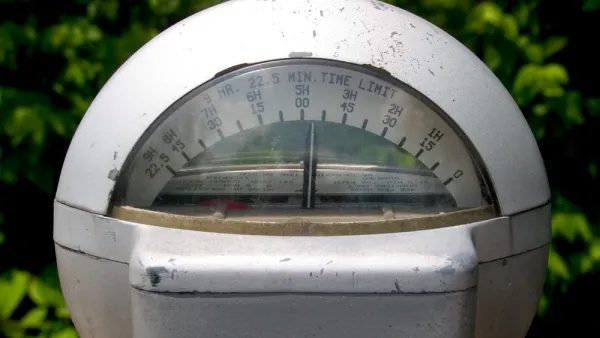
As the District Department of Transportation (DDOT) quickly approaches the May target for the launch of ParkDC, Greater Greater Washington takes a closer look at what the performance parking program will entail.


"In May, DDOT will launch its most robust performance parking experiment to date," reports Michael Perkins. "The program, called ParkDC, will significantly change how people park in Gallery Place: the cost to park a car on some of downtown's most in-demand blocks will rise or drop according to demand."
The ParkDC program was first announced in December, but remained mostly conceptual. Perkins, however, provides a lot more detail about how the program will work. Perkins also claims that ParkDC should improve over DDOT's initial attempts to pilot similar programs on Capitol Hill, Hill Street, and Columbia Heights. The difference this time, according to Perkins, are the "real-time cameras and occupancy sensors, along with a pre-announced schedule, [that] make the program smarter and more responsive."
Read the full story: DDOT's newest performance parking program will be its best
Washington D.C. Announces 'parkDC'—Value Pricing—for Downtown
Washington D.C. is ready for a change in parking policy. The District Department of Transportation announced plans, so far mostly conceptual, to launch the parkDC value pricing system next summer.
Study Details SFpark's Surprising Results
The preliminary results are in for America's most ambitious experiment in demand-based parking pricing. Among the surprises: the average price at the spaces participating in San Francisco's pioneering program actually declined by 1 percent.
Demand-Based Pricing for On-Street Parking Pilot Finds Success in D.C.
It's rare to see a policy so effective in achieving its goals.

Planetizen Federal Action Tracker
A weekly monitor of how Trump’s orders and actions are impacting planners and planning in America.

Eastern Nebraska is running out of electricity
Data centers and electrification are straining eastern Nebraska’s grid, throttling economic development.

Washington state to charge fee to drivers with fuel-efficient cars
Revenue from the fee will go towards supporting the state’s highways.

Instead of building new housing, LA developers are turning mansions into mega-mansions
In the richest areas, the number of houses valued at $30 million with demolition permits has skyrocketed since 2018.

Illinois considers spending $1 billion in taxpayer money on data center
A quantum computing campus and data center are currently under construction in Chicago.

As development costs rise, Boston moves to lessen affordable housing requirements
The Boston Zoning Commission and the City Council still need to approve Boston Mayor Michelle Wu’s proposed changes

FREE Course: Walkable City 1: Why Walkability?
After describing his path towards focusing on walkability as the essence of good planning, Jeff Speck marches through his five principal reasons for making more walkable places.
Reinventing Malls: Planning Alchemy—Turning Gray Fields Into Gold
The course focuses on the opportunities and imperatives that shape reinvention of mall sites.

City of Charlotte
City of Rosemead
Rutgers University, Edward J. Bloustein School of Planning and Public Policy
University of Michigan School for Environment and Sustainability (SEAS)
Hunter College, City University of New York (CUNY)
The Architects Foundation
University District Partnership
City of Cambridge
The Pocatello Development Authority