Can the Olympic bid provide an impetus for long-range planning for the Boston metropolitan area?


A column by Joseph Curtatone argues that the city of Boston should use the occasion of preparing a bid to host the 2024 Olympics by considering the needs of the city in 2124: "We should not be planning to host a three-week party. Instead, we should be looking to dovetail Olympic preparations with community-building initiatives. We pride ourselves in being national and international thought leaders and a Boston bid should advance the Olympic ideal, using the Games as a transformative event to better the lives of the people in the city/region where the Games take place."
Curtatone cites regionalism and transportation infrastructure as two areas that will require significant efforts to prepare for a role as host city. Curtatone also cites a recent Metropolitan Area Planning Council report [pdf], calling for 435,000 new housing units by 2040 to address the region's affordability efforts. "A Boston Olympics done right should embrace smart growth principles to net us thousands of new housing units," writes Curtatone.
Read the full story: Olympics a regional effort
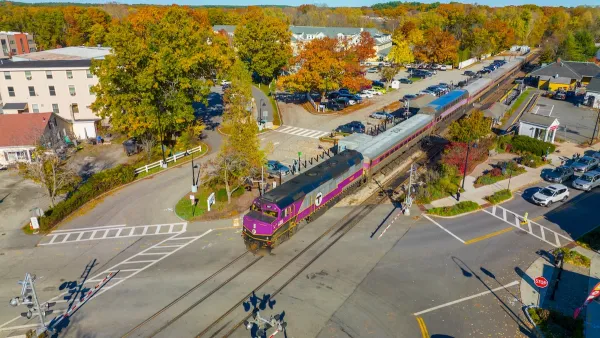
Massachusetts TOD Law Yielding Results
While some cities are fighting the state’s push to increase density near transit, others are already breaking ground on multifamily projects that will bring hundreds of new housing units online.

Boston Region Looking for Commuter Rail Fixes
The North-South Rail Link has been under discussion in the Boston region for Decades now. A new 'Rail Vision' process continues the discussion again.
Boston Neighborhoods Find Controversy Following Residential Zoning Changes
An in-depth look into the political controversies stirred up in the Boston neighborhood of Jamaica Plain as a result of a proposed, density-adding zoning plan.

Planetizen Federal Action Tracker
A weekly monitor of how Trump’s orders and actions are impacting planners and planning in America.

California plans to bury El Niño’s downpour
If the state plays its cards right, it may be able to store a billion acre-feet of El Niño’s water in aquifers.

Desperate measures: Advocates weigh draining Lake Powell to fill Colorado River
Draining the reservoir could reduce evaporation losses by a couple hundred thousand acre-feet.

Mamdani’s pied-à-terre tax survives legal challenge
A panel of judges found that the plaintiffs failed to demonstrate injury as a result of New York City's implementation of the tax.

Eastern Nebraska is running out of electricity
Data centers and electrification are straining eastern Nebraska’s grid, throttling economic development.

Seattle passes record-breaking transit services expansion
Proposition 1 will double the city’s transit tax to add 95,000 more bus trips and preserve 180,000 bus trips annually.

FREE Course: Walkable City 1: Why Walkability?
After describing his path towards focusing on walkability as the essence of good planning, Jeff Speck marches through his five principal reasons for making more walkable places.
Reinventing Malls: Planning Alchemy—Turning Gray Fields Into Gold
The course focuses on the opportunities and imperatives that shape reinvention of mall sites.

City of Rosemead
Rutgers University, Edward J. Bloustein School of Planning and Public Policy
One Hundred Miles
University of Michigan School for Environment and Sustainability (SEAS)
Hunter College, City University of New York (CUNY)
The Architects Foundation
City of Cambridge
Montrose County
The Pocatello Development Authority