The first bike super highway connecting Copenhagen and one of its suburbs was completed in 2012. That first, 11-mile leg only hints of the ambitious plans for the network.


Annemarie Zink writes about Denmark's "fast-growing network of bike infrastructure targeted specifically at suburban commuters, featuring smooth pavement, good lighting, separation from traffic, safe road crossings, rain shelters and air pumps." Copenhagen and 21 of its suburban neighbors are planning "[a] total of 28 routes with 467 km (290 miles) of cycle paths are planned. Eleven of these will be ready by the end of 2018."
At least some of the political support for the network was built from a 2008 survey finding that "one in three people who normally drive would switch to a bike if there were more direct bicycle tracks with a consistently high standard of quality from one municipality to the next." The network does not just provide straight lines to Copenhagen—there are suburb-to-suburb routes as well.
Zink provides additional details about the political and planning process that enabled the system as well as the ongoing project of maintaining the network.
Read the full story: Copenhagen bicycle “super highways” push regional cooperation to a new level

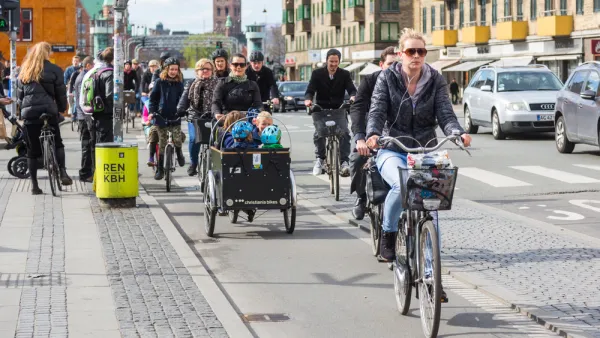
Copenhagen Update: On-Street Auto Parking Replaced by Bike Parking
Copenhagen may have already met its bicycling goal of 50 percent of modal share for commuting, but it needs to improve the share for all trips. With less funding available, the city is pursuing low cost strategies, such as auto parking removal.
Copenhagen Shames Aspiring Bike Cities, Again, With Opening of Superhighway
From Portland to Minneapolis, cities across the America have been trying to catch up to Copenhagen's world-renowned bicycling infrastructure. With the recent opening of a bike superhighway, the Danish capital is leaving other cities in the dust.
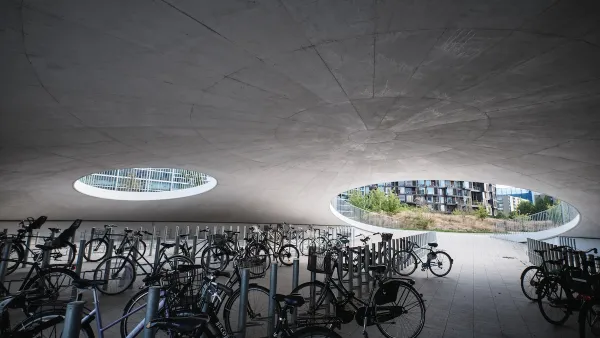
How Copenhagen Became a ‘Sponge City’
The Danish capital is implementing a massive, multi-pronged strategy to build resilience against flooding and shore up water supplies during drought periods.

Planetizen Federal Action Tracker
A weekly monitor of how Trump’s orders and actions are impacting planners and planning in America.

Amtrak, CN end decades-long dispute with eight-year agreement
The new operating agreement establishes an updated framework for the companies to work together, including processes to resolve disputes.

Judges permit Denver to divert 77,000 acre feet from the Colorado River for reservoir expansion
Overuse and climate change have caused the Colorado River’s water levels to plummet.

NYC DOT wants faster, more permanent street upgrades
The city is examining ways to build more concrete infrastructure without getting entangled in 'decades-long' projects.

'Something we’ve never seen before:' rising utility rates could strain city finances nationwide
Data centers, climate change and other factors have caused utility rates in the United States to increase by 38% since 2020.

Trump to overrule local leaders, lease millions of acres of America’s Pacific Island territories’ seafloors to mining companies
International law says that the Indigenous people of America’s territories have a right to prior and informed consent regarding projects that impact their countries.

FREE Course: Walkable City 1: Why Walkability?
After describing his path towards focusing on walkability as the essence of good planning, Jeff Speck marches through his five principal reasons for making more walkable places.
Reinventing Malls: Planning Alchemy—Turning Gray Fields Into Gold
The course focuses on the opportunities and imperatives that shape reinvention of mall sites.

Harvard University Graduate School of Design
KFH Group Inc.
Greater Baltimore Committee
The Architects Foundation
University of Cincinnati Online
The Pocatello Development Authority
The Urban Renewal Agency of the City of Pocatello