Are you thinking about playborhoods, playsheds, and free-range kids? Berlin's Kolle 37 hits it out of the park. Literally.


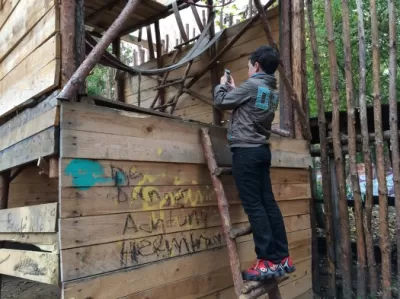
Hazel Borys shares some thoughts on the Berlin experiential park, Kolle 37. Project for Public Spaces does a great job of telling why it works, but Borys goes on to show how the park, like walkable urbanism, helps us become better parents.
"Much of what we’ve written about walkable urbanism and kids is all about resisting the urge to be helicopter parents that raise fragile, teacup children. With the help of a walkable neighborhood, it’s a little easier to experience that letting-go process, with slower cars, more eyes on the street, and a network of people you know and trust. Slowly, we’re letting free-range children happen again."
"In a similar sort of way, Kolle 37 introduces kids to some rather lethal tools – hatchets, fire, hammers, nails – with some coaches close-by to keep the Lord of the Flies away. Within relative safety, the kids have built their own play houses, bake bread in a wood-burning oven, throw some good-looking earthenware at the wheel, grow their own food, and raise some rabbits."

Kolle 37, Berlin. Image credit: Hazel Borys, Creative Commons Sharalike Licensing
Read the full story: Berliner Kinder: Berlin and its playborhoods

Planetizen Federal Action Tracker
A weekly monitor of how Trump’s orders and actions are impacting planners and planning in America.

Washington state to charge fee to drivers with fuel-efficient cars
Revenue from the fee will go towards supporting the state’s highways.

Illinois considers spending $1 billion in taxpayer money on data center
A quantum computing campus and data center are currently under construction in Chicago.

Did data centers change how voters cast their ballots?
Texas, Ohio, and Georgia all flipped party control. But in rural counties, the effect of local data centers was mixed.

Amtrak invests in eight new Airo trainsets
The new trainsets will begin serving passengers in 2031.

HUD to end aid for mixed-immigration-status households
The new rule is projected to impact 80,000 people, nearly half of whom are children.

FREE Course: Walkable City 1: Why Walkability?
After describing his path towards focusing on walkability as the essence of good planning, Jeff Speck marches through his five principal reasons for making more walkable places.
Reinventing Malls: Planning Alchemy—Turning Gray Fields Into Gold
The course focuses on the opportunities and imperatives that shape reinvention of mall sites.

City of Charlotte
City of Rosemead
Rutgers University, Edward J. Bloustein School of Planning and Public Policy
University of Michigan School for Environment and Sustainability (SEAS)
Hunter College, City University of New York (CUNY)
The Architects Foundation
University District Partnership