The reopening of Denver's Union Station last weekend provides an opportunity to reflect on the importance of rail, with its hub at Union Station, in establishing Denver, as well as the city's multi-modal future, again with its hub as Union Station.


Pat Mack writes a post to supplement a radio interview with University of Colorado Denver history professor Tom Noel, who claims that Union Station is "arguably the most important building in the city."
Noel tells the story of the time when the Transcontinental Railroad chose a route that went through Cheyenne, Wyoming, which caused half of Denver's population to leave Denver. "But civic leaders in Denver, including former territorial Gov. John Evans and Rocky Mountain News founder William N. Byers….raised the money to build the Denver Pacific Railway which connected Denver to Cheyenne in 1870. That prompted other rail lines to be built from the Transcontinental Railroad to Denver as well."
Denver's early connection to the outside world also drove development in the city, as explained by Mack: "The layout of Denver revolves around the station. With 17th Street running to the station, the road became Denver's main street. That is still seen today by the warehouse buildings, office towers and hotels that line the road."
The radio conversation between Mack and Noel also includes some more details about the history of Denver and the importance of the Union Station makeover to the city.
Read the full story: Professor: Union Station most important building in Denver
Denver's Historic Union Station Gets Grand Opening Today
Called one of the most complex public works projects in Denver's history, Denver's new Union Station will lie at the center of a rapidly growing rail and transit network.
Analysis: Denver's 20-Year Vision for Not-Quite-Complete Streets
The Denveright plan puts pedestrians first, but could do more for public transportation and bikes, says a critique from Streetsblog Denver.
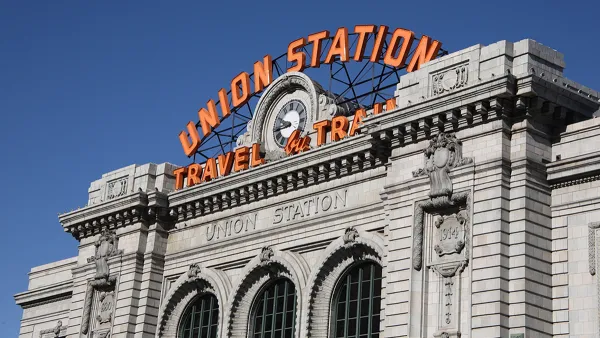
Denver's New Commuter Rail Line to Airport to Open in April
You will be forgiven for thinking you are looking at an East Coast commuter rail line: It's electrified with level boarding, mostly 15-minute headways, with bike and luggage racks, operating 22 hours a day from Denver's Union Station to the airport.

Planetizen Federal Action Tracker
A weekly monitor of how Trump’s orders and actions are impacting planners and planning in America.

California plans to bury El Niño’s downpour
If the state plays its cards right, it may be able to store a billion acre-feet of El Niño’s water in aquifers.

Desperate measures: Advocates weigh draining Lake Powell to fill Colorado River
Draining the reservoir could reduce evaporation losses by a couple hundred thousand acre-feet.

Chicago voters approve permanent festival grounds, penalty for vacant property owners
Currently, major summer and fall festivals take over public parks for weeks at a time, drawing criticism from nearby residents

NYC votes to cut outdoor dining red tape, speed up permitting
New York City also voted to allow the Department of Transportation to begin work on urgent projects before notifying elected officials.

California appears to reject Prop. 45
The proposition would have expanded the projects that qualify for a streamlined environmental review, effectively paring down the California Environmental Quality Act.

FREE Course: Walkable City 1: Why Walkability?
After describing his path towards focusing on walkability as the essence of good planning, Jeff Speck marches through his five principal reasons for making more walkable places.
Reinventing Malls: Planning Alchemy—Turning Gray Fields Into Gold
The course focuses on the opportunities and imperatives that shape reinvention of mall sites.

City of Rosemead
Rutgers University, Edward J. Bloustein School of Planning and Public Policy
One Hundred Miles
Hunter College, City University of New York (CUNY)
The Architects Foundation
University of Cincinnati Online
City of Cambridge
Montrose County
The Pocatello Development Authority