Architect Dave Hampton reviews the 2nd annual Urban Sciences Research Coordination Network workshop held June 11 in Chicago.


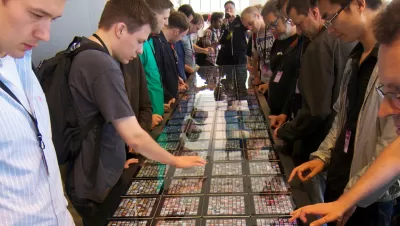
Architect Dave Hampton wondered what his work had in common with that of computer and social scientists.
However, after accepting an invitation (upon being assured he wouldn’t be viewed as “interloper”) from a computer scientist he knew to attend the 2nd annual Urban Sciences Research Coordination Network workshop held on June 11 in Chicago, Hampton shares that he found that “big data” is relevant across several disciplines.
“After having Charlie allay my fears and settling in, aside from the occasional inevitable bits of specialized-disciplinary jargon, my stereotypes of what a computer and social science conference would be were quickly neutralized,” Hampton wrote. “Presentations were clear, compelling, and made the case that ‘big data’ was more than buzz – it was immensely useful across a variety of disciplines, and with wide-reaching, transformational implications in our lives.”
Computers can be used to calculate the impacts of design over decades, Hampton said he learned.
He recounts what the various speakers at the workshop discussed and he shares his three takeaways from the workshop.
Read the full story: City of Big Data: Creators and Interpreters

4 Urban Analytics and Modeling Trends to Watch in 2020
Urban analytics has the potential to benefit both planners and the world. Here' are a few ways that new data-based approaches can open new levels of analysis and understanding.

Sidewalk Labs Debuts New Generative Design Tool
A new generative tool developed by Sidewalk Labs uses machine learning and computational design to generate millions of comprehensive planning scenarios.
Planning Lessons from an Olympic Beauty Contest
Last week, my home city, Los Angeles, lost out to Chicago for the right to represent the United States in the international competition to host the 2016 Olympics. Since an Olympic city selection represents the ultimate inter-urban beauty contest – dare I say, a kind of urban “International Idol” – what did this process tell us about the state of urban planning in two of America’s largest cities?

Planetizen Federal Action Tracker
A weekly monitor of how Trump’s orders and actions are impacting planners and planning in America.

California plans to bury El Niño’s downpour
If the state plays its cards right, it may be able to store a billion acre-feet of El Niño’s water in aquifers.

Desperate measures: Advocates weigh draining Lake Powell to fill Colorado River
Draining the reservoir could reduce evaporation losses by a couple hundred thousand acre-feet.

Mamdani’s pied-à-terre tax survives legal challenge
A panel of judges found that the plaintiffs failed to demonstrate injury as a result of New York City's implementation of the tax.

Eastern Nebraska is running out of electricity
Data centers and electrification are straining eastern Nebraska’s grid, throttling economic development.

Seattle passes record-breaking transit services expansion
Proposition 1 will double the city’s transit tax to add 95,000 more bus trips and preserve 180,000 bus trips annually.

FREE Course: Walkable City 1: Why Walkability?
After describing his path towards focusing on walkability as the essence of good planning, Jeff Speck marches through his five principal reasons for making more walkable places.
Reinventing Malls: Planning Alchemy—Turning Gray Fields Into Gold
The course focuses on the opportunities and imperatives that shape reinvention of mall sites.

City of Rosemead
Rutgers University, Edward J. Bloustein School of Planning and Public Policy
One Hundred Miles
University of Michigan School for Environment and Sustainability (SEAS)
Hunter College, City University of New York (CUNY)
The Architects Foundation
City of Cambridge
Montrose County
The Pocatello Development Authority