San Mateo residents sue a Silicon Valley tycoon for buying and closing off a public beach in violation of California Coastal Act.


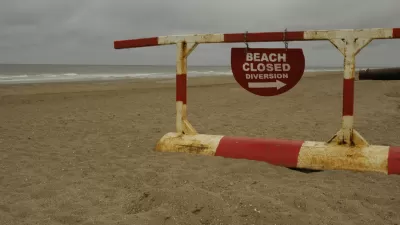
The San Francisco Chronicle reports that on Monday, Vinod Khosla, a Silicon Valley entrepreneur who co-founded Sun Microsystems, had his first day in court following his purchase of Martins Beach in San Mateo County, California.
The beach, which has been open to the public for more than a century, is now gated off, and protected by armed security. The only way onto the beach is from the water.
"You can’t just go down and buy a beach from the city and county of San Mateo and close the beach down," Joe Cotchett, who represents the Surfrider Foundation, told the local CBS affiliate. "We hope that the court, after a trial, will order Mr. Khosla to follow the law and apply for a permit to close down the beach." Cochett, who represents the Surfrider foundation in filing the suit.
Plaintiffs claim Khosla’s disfiguration of a billboard on-site constitutes new development, requiring a permit that Khosla never applied for. During the hearing, Vinod remained "evasive and uncooperative.”
This raises new questions on how the acquisition of public lands by increasingly wealthy, insular owners affects the enclosure of public space and other recreational areas.
Read the full story: Martins Beach billionaire evades questions on stand
Court Ruling for Beach-Blocking Billionaire Redeems Public Access
Vinod Khosla, the California billionaire who made news earlier this year for blocking access to a public beach, had his day in court.
The Inequities of Beach Access
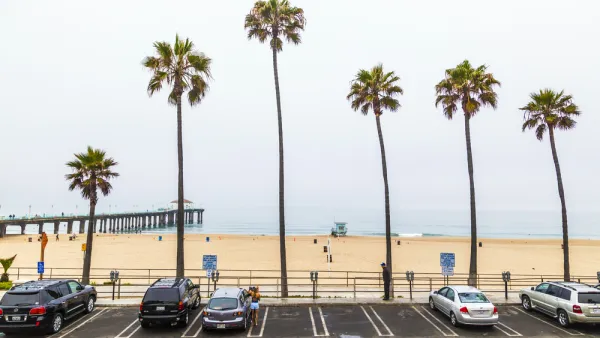
Over 80% of Californians live within an hour’s drive of a beach, but that does not mean that everyone has easy access to beaches.
Long Beach Gated Community Must Provide Public Access
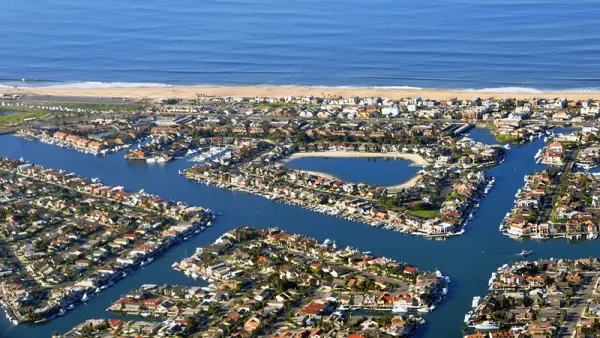
The development never fulfilled its mandate to build a public walkway through its property. Now, the Coastal Commission wants it to open its gates.

Planetizen Federal Action Tracker
A weekly monitor of how Trump’s orders and actions are impacting planners and planning in America.

California plans to bury El Niño’s downpour
If the state plays its cards right, it may be able to store a billion acre-feet of El Niño’s water in aquifers.

Desperate measures: Advocates weigh draining Lake Powell to fill Colorado River
Draining the reservoir could reduce evaporation losses by a couple hundred thousand acre-feet.

Mamdani’s pied-à-terre tax survives legal challenge
A panel of judges found that the plaintiffs failed to demonstrate injury as a result of New York City's implementation of the tax.

Eastern Nebraska is running out of electricity
Data centers and electrification are straining eastern Nebraska’s grid, throttling economic development.

Seattle passes record-breaking transit services expansion
Proposition 1 will double the city’s transit tax to add 95,000 more bus trips and preserve 180,000 bus trips annually.

FREE Course: Walkable City 1: Why Walkability?
After describing his path towards focusing on walkability as the essence of good planning, Jeff Speck marches through his five principal reasons for making more walkable places.
Reinventing Malls: Planning Alchemy—Turning Gray Fields Into Gold
The course focuses on the opportunities and imperatives that shape reinvention of mall sites.

City of Rosemead
Rutgers University, Edward J. Bloustein School of Planning and Public Policy
One Hundred Miles
University of Michigan School for Environment and Sustainability (SEAS)
Hunter College, City University of New York (CUNY)
The Architects Foundation
City of Cambridge
Montrose County
The Pocatello Development Authority