The development never fulfilled its mandate to build a public walkway through its property. Now, the Coastal Commission wants it to open its gates.


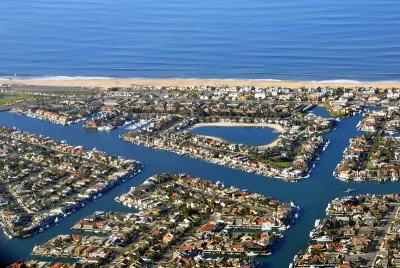
After the discovery that a decades-old agreement to provide public access through the gated Bay Harbour community in Long Beach was never fulfilled, the neighborhood may be forced to finally build walkways. As Anthony Pignataro reports in the Long Beach Post, "public access was to be in the form of 10-foot-wide pathways through the property that would allow pedestrian and bicycle traffic to move through the neighborhood to both Jack Nichol Park and the Los Cerritos Channel." More than 40 years later, "the state agency tasked with ensuring public access through the development is trying to get the walkways built."
"Since its founding in 1972, a key mission of the California Coastal Commission has been to maximize public access to and along the shoreline." When the Commission approved Bay Harbour's construction(then named Costa del Sol) in 1977, one of the conditions for approval "required that a public easement traverse the 'greenbelt' of grass and trees that ran through the development like a plus-sign." But the California Coastal Conservancy, the agency that was tasked with administering the easement, did not enforce compliance and discovered, in 2019, that the neighborhood's gates prevent public access.
"[T]he Conservancy is currently working with the Coastal Commission and Bay Harbour 'to find a solution that provides for public access and is agreeable to everyone,'" said Conservancy project manager Joel Gerwein. Meanwhile, the city is "working with the HOA on 'minor, small enhancements' that can be made around the community and at nearby Jack Nichol Park to ensure better public access."
FULL STORY: Exclusive housing development must open its gates to the public, Coastal Commission says


California Coastal Commission Nixes Parking Reforms Intended to Spur ADUs in San Diego
Environmental causes run into conflict with zoning reforms intended for environmental benefit once again, as the California Coastal Commission requires San Diego to reinstate parking requirements for ADUs.
The Inequities of Beach Access
Over 80% of Californians live within an hour’s drive of a beach, but that does not mean that everyone has easy access to beaches.
Oceanside Debates the Future of its Coastline
As sea levels rise, California's coastal communities face difficult decisions about how to preserve coastlines and mitigate the looming threat.

The state-sanctioned urbicide of Austin
People don’t kill cities. Freeways do.

US to reduce Colorado River water deliveries to Mexico
A new Colorado Treaty amendment reduces Mexico’s Colorado River water allocation by 250,000 acre feet.

New Jersey’s second-largest city bans standalone data centers
Jersey City will continue to allow co-location facilities, such as those meant for research institutions that store their own data.

Amtrak not solely to blame for New Jersey commuter rail's unreliability, report finds
A new study from the Garden State Initiative found that NJ Transit’s budget grew 20% across a 4 year period, but reliability declined significantly over the same period.

EPA erases limits on planet-warming pollution from power plants
Under Monday’s plan, power plants would still have some limits on how much mercury, arsenic and other contaminants they can emit.

Phoenix announces new on-demand transit service, more frequent RAPID buses
Both new services will launch in October, and are part of Phoenix's Project Effective Access Solutions for Easing Congestion.

FREE Course: Walkable City 1: Why Walkability?
After describing his path towards focusing on walkability as the essence of good planning, Jeff Speck marches through his five principal reasons for making more walkable places.
Reinventing Malls: Planning Alchemy—Turning Gray Fields Into Gold
The course focuses on the opportunities and imperatives that shape reinvention of mall sites.


Eagle County Government
Harvard University Graduate School of Design
Nashville Planning Department
The Architects Foundation
University of Cincinnati Online
The Pocatello Development Authority
The Urban Renewal Agency of the City of Pocatello
Journal of the American Planning Association