As sea levels rise, California's coastal communities face difficult decisions about how to preserve coastlines and mitigate the looming threat.


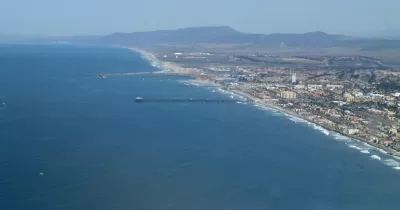
"Whether the width of the beach is shrinking due to climate change and rising sea levels, coastal development or both, the fact of the matter is: Oceanside, like many of Southern California coastal communities, is struggling to protect its beachfront properties." Now, as MacKenzie Elmer reports in Voice of San Diego, a tense debate between city officials and the California Coastal Commission "is adding fuel to a larger debate over what Oceanside should do about its shrinking coastline."
Unlike other California cities, "allows property owners to do certain types of repair work to their boulder walls – called revetments – without having to get a coastal development permit," but "[t]he city restricts how much, what type and where material can be placed, and Oceanside’s engineering staff reviews the plans to make sure they follow wall-design standards." However, a lack of proactive enforcement means that work frequently happens without city approval, including illegal practices like pouring concrete between the boulders.
"But there’s a bigger issue at stake than permitting maintenance work. The city of Oceanside is updating what’s known as a Local Coastal Program, which spells out the types of development and projects that need Coastal Commission permission. The Coastal Commission also needs to sign off on any city’s Local Coastal Program. Oceanside is also working through its own assessment of how climate change is going to shrink the beach and endanger coastal homes down the line, a process that involves studying how to add and keep sand on the beach." Although not yet on the table in Oceanside, some coastal communities are evaluating plans for "managed retreat" as rising waters and erosion threaten coastal development.
Read the full story: Oceanside Seawall Dispute Hints at Looming Decisions Over Sea-Level Rise

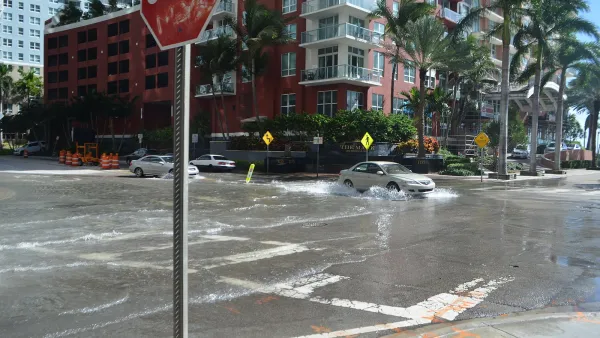
Miami Residents Resist the Idea of a 20-Foot Seawall
As climate change accelerates sea level rise and flooding in South Florida, locals hope to mitigate the impacts with less dramatic interventions.
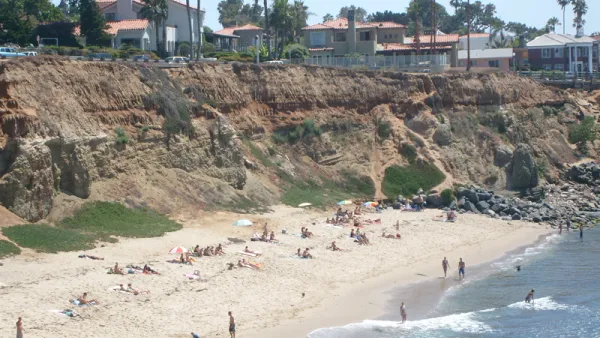
Coastal City Rejects 'Managed Retreat' Strategy
Del Mar, in Southern California, says it does not want to adopt the approach as part of its sea-level rise adaptation plan.
Protecting California's Coastal Development Will Cost Billions
Computer modeling predicts sea levels rising 55 inches by 2100, and a recent report from California's interagency Climate Action Team is calling for a radical reorganization of the state's coastal development and infrastructure to avoid disaster.

Planetizen Federal Action Tracker
A weekly monitor of how Trump’s orders and actions are impacting planners and planning in America.

Amtrak, CN end decades-long dispute with eight-year agreement
The new operating agreement establishes an updated framework for the companies to work together, including processes to resolve disputes.

Nation's most wind-powered state turns to coal as data centers increase energy demand
For the first time in decades, Iowa has increased its generation of coal power.

Alabama scores up to $2.5 billion federal loan for largest infrastructure project in state’s history
The Mobile River Bridge and Bayway Project aims to ease congestion at Alabama’s worst bottleneck.

Trump is considering data centers on 6 states' public land — some state officials say they had no idea
If the administration approves the proposed projects, data center and data center-related developments will cover 17,600 acres of public land.

Despite court ruling, Trump is keeping nearly all wind projects in the US on hold
At least 110 wind energy projects have not heard from the government since a federal judge ruled that the Trump administration's freeze on wind turbine clearances was likely illegal.

FREE Course: Walkable City 1: Why Walkability?
After describing his path towards focusing on walkability as the essence of good planning, Jeff Speck marches through his five principal reasons for making more walkable places.
Reinventing Malls: Planning Alchemy—Turning Gray Fields Into Gold
The course focuses on the opportunities and imperatives that shape reinvention of mall sites.


KFH Group Inc.
Greater Baltimore Committee
Eagle County Government
The Architects Foundation
University of Cincinnati Online
The Pocatello Development Authority
The Urban Renewal Agency of the City of Pocatello