Americans tend to pay more attention to wind strength than storm surge when evaluating whether or not to evacuate before a hurricane. A new NOAA mapping project is designed to change perceptions about the multiple risks of storm events.


The National Oceanic and Atmospheric Administration (NOAA) will begin mapping coastal regions in varying hues to represent the danger represented by storm surge, according to a recent article by Barbara Liston.
Recent polls determined the Americans tend to consider wind strength above storm surge when considering evacuation—a mistake that proved costly during Hurricane Sandy in 2012 and Hurricane Ike in 2008.
The new maps are intended to provide residents of coastal areas a clearer understanding of the multiple risks posed by Hurricanes. Forty-eight hours prior to the landfall of a hurricane, the NOAA will begin releasing color-coded maps indicating the risk of flooding, updating them every six hours.
Read the full story: New hurricane forecast maps to show flood risk from storm surge

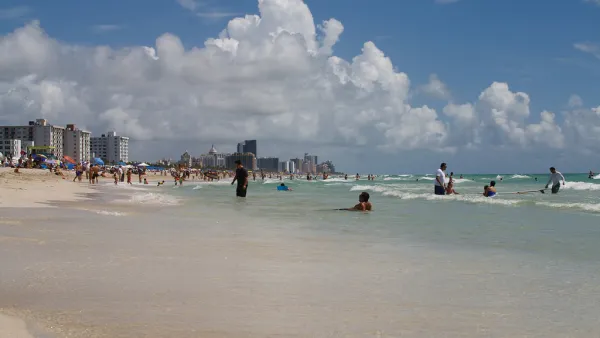
Miami Beach: A Four-Foot High Barrier Island Awaited Irma
A city of almost 92,000 people sits on a one-mile wide island designed by nature to protect the mainland from ocean swells, storms, and hurricanes. The seven-mile long island, which floods even when sunny, was spared from catastrophic storm surge.
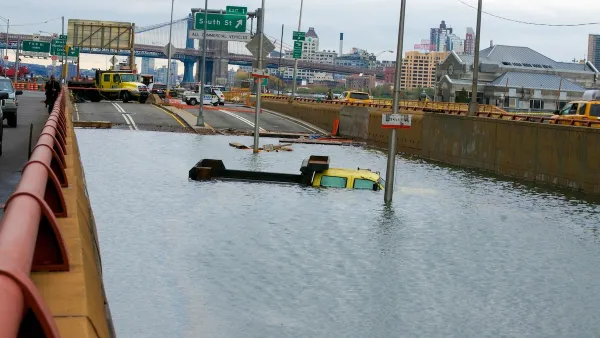
Over a Quarter of US Homes Face ‘Severe or Extreme’ Climate Risk
The number of U.S. homes at risk from hurricanes, fires, or flooding is valued at close to $13 trillion.
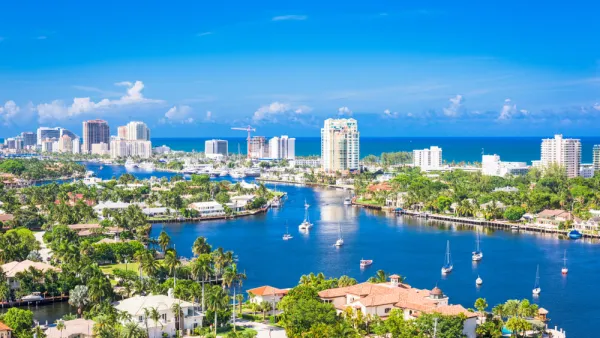
Hurricane Ian Puts Renewed Focus on Florida's Barrier Islands
Ian did not impact Southeast Florida, but coastal residents there took notice of the state's deadliest hurricane since 1935 that devastated much of Southwest Florida last month, particularly the barrier islands off the Gulf Coast.

Planetizen Federal Action Tracker
A weekly monitor of how Trump’s orders and actions are impacting planners and planning in America.

Amtrak, CN end decades-long dispute with eight-year agreement
The new operating agreement establishes an updated framework for the companies to work together, including processes to resolve disputes.

Judges permit Denver to divert 77,000 acre feet from the Colorado River for reservoir expansion
Overuse and climate change have caused the Colorado River’s water levels to plummet.

NYC DOT wants faster, more permanent street upgrades
The city is examining ways to build more concrete infrastructure without getting entangled in 'decades-long' projects.

'Something we’ve never seen before:' rising utility rates could strain city finances nationwide
Data centers, climate change and other factors have caused utility rates in the United States to increase by 38% since 2020.

Trump to overrule local leaders, lease millions of acres of America’s Pacific Island territories’ seafloors to mining companies
International law says that the Indigenous people of America’s territories have a right to prior and informed consent regarding projects that impact their countries.

FREE Course: Walkable City 1: Why Walkability?
After describing his path towards focusing on walkability as the essence of good planning, Jeff Speck marches through his five principal reasons for making more walkable places.
Reinventing Malls: Planning Alchemy—Turning Gray Fields Into Gold
The course focuses on the opportunities and imperatives that shape reinvention of mall sites.

Harvard University Graduate School of Design
KFH Group Inc.
Greater Baltimore Committee
The Architects Foundation
University of Cincinnati Online
The Pocatello Development Authority
The Urban Renewal Agency of the City of Pocatello