The price tag for massive project to bridge the Ohio River in Louisville, Kentucky complete with dual approach tunnels, has long been a source of controversy. Another sudden cost increase has one commenter wondering how this keeps happening.


Aaron Renn checks in with the “Indiana Big-Dig” aka “The Tunnel Under the Trees” aka “The Boondoggle Ohio River Bridges project”—a 2.6 billion highway project that is the work of the departments of transportation in Kentucky and Indiana. After Indiana claimed to have found $209 million on the project due to design changes, Renn caught a mysterious price increase in a recent news report.
“Remember that $260 million tunnel under the trees in Louisville?…Would you believe the price went up by almost $80 million at the same time Indiana claimed it ‘saved’ $209 million on it through design changes? Of course you would.”
“Yesterday the Courier Journal reported that the actual tunnel was cost $338 million – that’s a $78 million increase over 2010 and a $36 million increase over our max burn scenario in 2012.”
Renn also presents a couple of possible scenarios to explain the loose math, but neither of them are particularly flattering to the state DOTs.
Read the full story: How State DOT Math Works
In Indiana, Highway Building Is an End in Itself
As the first segment of the new $2-3 billion freeway called I-69 linking Evansville and Indianapolis nears completion, Southwest Indiana leaders are already agitating to build the state's next "massive boondoggle," writes Aaron Renn.
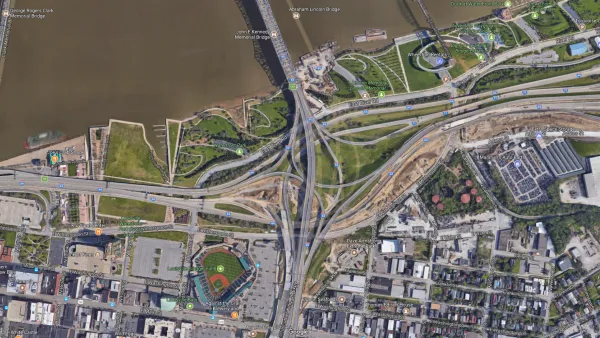
Louisville's Infamous Spaghetti Junction to Get Safety Review
Three tractor trailers overturned in less than a month while navigating Spaghetti Junction in Louisville—the maze of twisting ramps and interchanges that sparked viral notoriety at the end of 2016.
Critiquing Louisville's New Ohio River Bridge Tolls
Many in the urbanism community were shocked to see the scale of the recently completed "Spaghetti Junction" in Louisville, but the tolling system that will fund the project is just as critical to consider.

Planetizen Federal Action Tracker
A weekly monitor of how Trump’s orders and actions are impacting planners and planning in America.

California plans to bury El Niño’s downpour
If the state plays its cards right, it may be able to store a billion acre-feet of El Niño’s water in aquifers.

Desperate measures: Advocates weigh draining Lake Powell to fill Colorado River
Draining the reservoir could reduce evaporation losses by a couple hundred thousand acre-feet.

Post election, Texas is no longer Musk’s 'AI oasis'
Elon Musk dolled out $446 million on the 2026 midterms, the most ever spent by a non-canidate.

Chicago voters approve permanent festival grounds, penalty for vacant property owners
Currently, major summer and fall festivals take over public parks for weeks at a time, drawing criticism from nearby residents

NYC votes to cut outdoor dining red tape, speed up permitting
New York City also voted to allow the Department of Transportation to begin work on urgent projects before notifying elected officials.

FREE Course: Walkable City 1: Why Walkability?
After describing his path towards focusing on walkability as the essence of good planning, Jeff Speck marches through his five principal reasons for making more walkable places.
Reinventing Malls: Planning Alchemy—Turning Gray Fields Into Gold
The course focuses on the opportunities and imperatives that shape reinvention of mall sites.

City of Rosemead
Rutgers University, Edward J. Bloustein School of Planning and Public Policy
One Hundred Miles
Hunter College, City University of New York (CUNY)
The Architects Foundation
University of Cincinnati Online
City of Cambridge
Montrose County
The Pocatello Development Authority