As the first segment of the new $2-3 billion freeway called I-69 linking Evansville and Indianapolis nears completion, Southwest Indiana leaders are already agitating to build the state's next "massive boondoggle," writes Aaron Renn.


"What this actually shows is that for a lot of people, building highways is an end itself. There will never be a day when people aren’t pushing some sort of massive boondoggle. It may well be that the state hasn’t agreed to build [the so-called I-67]. But it’s also early. Few of Indiana’s major projects, whether that be the Illiana Expressway, I-69, or the Ohio River Bridges, were cooked up by the engineers in INDOT’s planning department. Instead, they were local priorities that over time became 'high priority' projects for the state."
"Without much else to offer economic hope to fading rural areas, small towns, and old small industrial cities, highway construction is easy snake oil solution," he concludes. "No amount of highway construction will ever satiate this never-ending demand for yet more mega-roads."
Read the full story: Highways, Casinos, and Bridges, Or the Insatiable Demand for Boondoggle Highways
Ohio River Bridges Project Price Tag Climbs Again, but Why?
The price tag for massive project to bridge the Ohio River in Louisville, Kentucky complete with dual approach tunnels, has long been a source of controversy. Another sudden cost increase has one commenter wondering how this keeps happening.
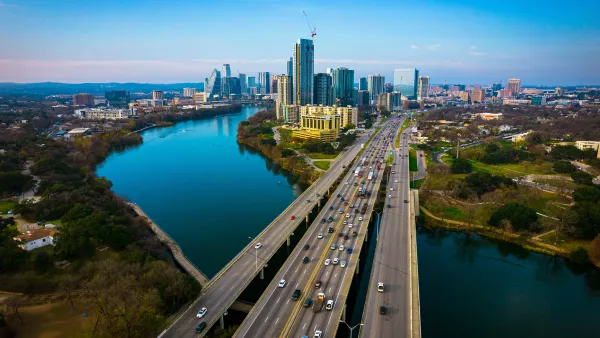
$138 billion Texas transportation plan to prioritize “Clear Lanes” congestion relief, highway construction
The plan includes $95 billion for transportation projects using existing state and federal revenue sources and $45 billion for project development and maintenance.
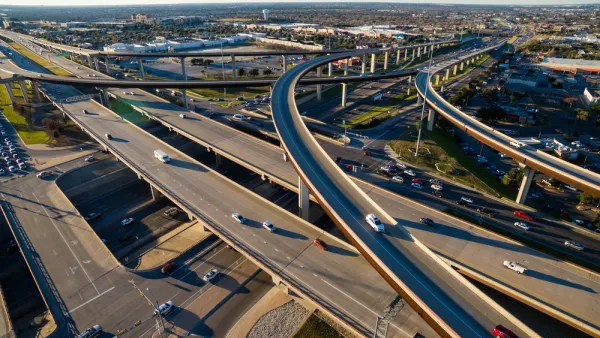
Texas Approves Plan that Calls for $104B for Roads and Highways
The latest iteration of Texas’s 10-year unified transportation plan sets a record for highway spending in the state.

Planetizen Federal Action Tracker
A weekly monitor of how Trump’s orders and actions are impacting planners and planning in America.

California plans to bury El Niño’s downpour
If the state plays its cards right, it may be able to store a billion acre-feet of El Niño’s water in aquifers.

Desperate measures: Advocates weigh draining Lake Powell to fill Colorado River
Draining the reservoir could reduce evaporation losses by a couple hundred thousand acre-feet.

Seattle passes record-breaking transit services expansion
Proposition 1 will double the city’s transit tax to add 95,000 more bus trips and preserve 180,000 bus trips annually.

Post election, Texas is no longer Musk’s 'AI oasis'
Elon Musk dolled out $446 million on the 2026 midterms, the most ever spent by a non-canidate.

Chicago voters approve permanent festival grounds, penalty for vacant property owners
Currently, major summer and fall festivals take over public parks for weeks at a time, drawing criticism from nearby residents

FREE Course: Walkable City 1: Why Walkability?
After describing his path towards focusing on walkability as the essence of good planning, Jeff Speck marches through his five principal reasons for making more walkable places.
Reinventing Malls: Planning Alchemy—Turning Gray Fields Into Gold
The course focuses on the opportunities and imperatives that shape reinvention of mall sites.

City of Rosemead
Rutgers University, Edward J. Bloustein School of Planning and Public Policy
One Hundred Miles
Hunter College, City University of New York (CUNY)
The Architects Foundation
University of Cincinnati Online
City of Cambridge
Montrose County
The Pocatello Development Authority