A move by Mexico City's mayor to raise fares for the city's run-down, but essential, subway system by 66 percent has sparked a protest movement.


"A recent increase in subway fares in Mexico City has touched off a protest movement of civil disobedience — with infuriated young commuters jumping over turnstiles to make their point — and has ignited a new round of political trouble for the capital's besieged mayor," report Tracy Wilkinson and Cecilia Sanchez.
Though the price hike for the heavily subsidized system only increases fares to 5 pesos (or the equivalent of 40 cents), commuters are angry about the lack of public consultation and unclear plans for how the increased revenues will improve the run-down system. Furthermore, write Wilkinson and Sanchez, "The furor makes it clear just how close to the economic edge many Mexican families find themselves. Nearly half the workforce is employed in the precarious informal economy, and even for wage earners formally employed, the pay is low."
Last June, proposed bus fare increases sparked mass demonstrations in Brazil's largest cities.
"I want to tell [Mexico City Mayor Miguel Angel] Mancera," said commuter Mariana Escalona, a 22-year-old engineering student, "that when the subway stations are clean, when there are more trains, when the vendors are gone, when there is more security, more protection for women riders and when there is good service, then I will be happy to pay 5 pesos."
FULL STORY: Mexico City subway rate increase enrages commuters

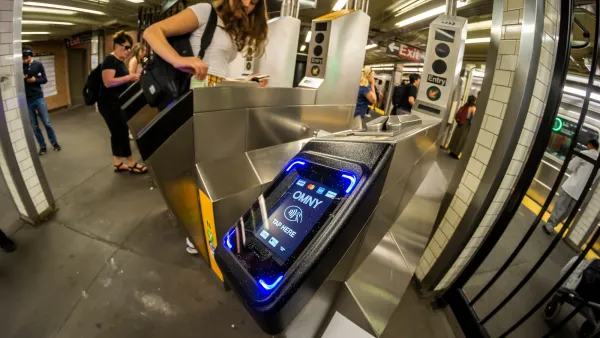
Popular transit payment system linked to Palantir could give ICE access to rider data
The tap-to-pay system is being used widely in transit systems including New York City, Boston and Chicago.
Report: Expanding MTA Fair Fares subway program would benefit New Yorkers more than free buses
A report from the city's Citizens Budget Commission recommends subsidizing fares for more low-income subway riders rather than making buses free for everyone.
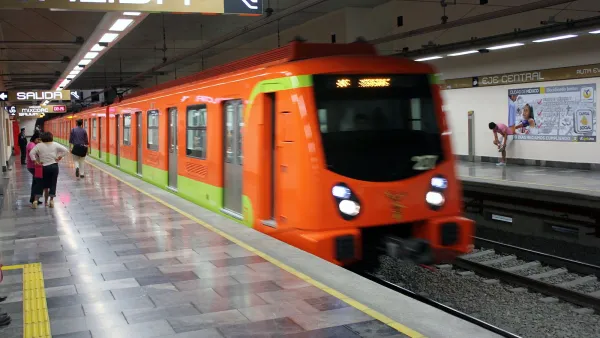
Report: Collapsed Mexico City Train Line Had Major Structural Flaws
A New York Times investigation uncovered years of government documents showing that officials ignored warnings about major structural flaws and poorly performed work on the train line before its fatal collapse in May.

Planetizen Federal Action Tracker
A weekly monitor of how Trump’s orders and actions are impacting planners and planning in America.

The state-sanctioned urbicide of Austin
People don’t kill cities. Freeways do.

US to reduce Colorado River water deliveries to Mexico
A new Colorado Treaty amendment reduces Mexico’s Colorado River water allocation by 250,000 acre feet.

Mamdani overhauls NYC's Vision Zero plan with 100 new policy goals
The overhaul aims to reduce traffic deaths and make streets safer for pedestrians, cyclists and drivers through lower speed limits, new safety infrastructure and more.

Amtrak not solely to blame for New Jersey commuter rail's unreliability, report finds
A new study from the Garden State Initiative found that NJ Transit’s budget grew 20% across a 4 year period, but reliability declined significantly over the same period.

EPA erases limits on planet-warming pollution from power plants
Under Monday’s plan, power plants would still have some limits on how much mercury, arsenic and other contaminants they can emit.

FREE Course: Walkable City 1: Why Walkability?
After describing his path towards focusing on walkability as the essence of good planning, Jeff Speck marches through his five principal reasons for making more walkable places.
Reinventing Malls: Planning Alchemy—Turning Gray Fields Into Gold
The course focuses on the opportunities and imperatives that shape reinvention of mall sites.

Eagle County Government
Harvard University Graduate School of Design
Nashville Planning Department
The Architects Foundation
University of Cincinnati Online
The Pocatello Development Authority
The Urban Renewal Agency of the City of Pocatello
Journal of the American Planning Association