Turnstiles are coming to the Los Angeles subway. Some say the move will help raise revenue for the city's transit authority, given its recent increases in ridership.


"Initially considered too costly to install given projected ridership numbers, subway turnstiles are absent from Los Angeles subway stations. In fact, LA Metro is the only major transit agency in the U.S. that doesn't use subway turnstiles and security gates. This means that riders can, and do, waltz through stations without paying, undeterred by intermittent ticket checks and fines that run up to $250. As it turns out, more and more Angelenos are using the subway and those unpaid train tickets are adding up. Metro estimates that fare-evaders cost the system $5 million a year in lost revenue."
Critics have argued that the costs of installing the turnstiles outweigh the possible revenue increase, but no hard figures are available yet.
Read the full story: Freeloaders, Beware: L.A. Now Has Subway Turnstiles
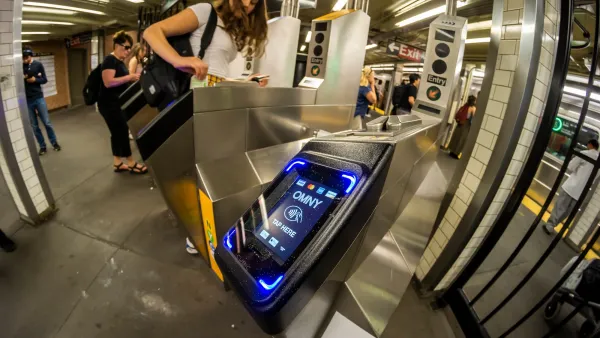
Popular transit payment system linked to Palantir could give ICE access to rider data
The tap-to-pay system is being used widely in transit systems including New York City, Boston and Chicago.
Report: Expanding MTA Fair Fares subway program would benefit New Yorkers more than free buses
A report from the city's Citizens Budget Commission recommends subsidizing fares for more low-income subway riders rather than making buses free for everyone.
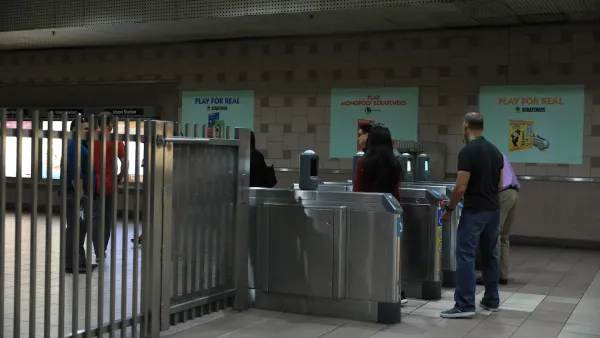
Commentary: By Quietly Ignoring Fare Evasion, LA Metro Inadvertently Became the Nation’s Largest Free Transit Experiment
Since the agency switched to in-house security, fare enforcement citations have plummeted.

Planetizen Federal Action Tracker
A weekly monitor of how Trump’s orders and actions are impacting planners and planning in America.

Eastern Nebraska is running out of electricity
Data centers and electrification are straining eastern Nebraska’s grid, throttling economic development.

Washington state to charge fee to drivers with fuel-efficient cars
Revenue from the fee will go towards supporting the state’s highways.

Instead of building new housing, LA developers are turning mansions into mega-mansions
In the richest areas, the number of houses valued at $30 million with demolition permits has skyrocketed since 2018.

Illinois considers spending $1 billion in taxpayer money on data center
A quantum computing campus and data center are currently under construction in Chicago.

As development costs rise, Boston moves to lessen affordable housing requirements
The Boston Zoning Commission and the City Council still need to approve Boston Mayor Michelle Wu’s proposed changes

FREE Course: Walkable City 1: Why Walkability?
After describing his path towards focusing on walkability as the essence of good planning, Jeff Speck marches through his five principal reasons for making more walkable places.
Reinventing Malls: Planning Alchemy—Turning Gray Fields Into Gold
The course focuses on the opportunities and imperatives that shape reinvention of mall sites.

City of Charlotte
City of Rosemead
Rutgers University, Edward J. Bloustein School of Planning and Public Policy
University of Michigan School for Environment and Sustainability (SEAS)
Hunter College, City University of New York (CUNY)
The Architects Foundation
University District Partnership
City of Cambridge
The Pocatello Development Authority