The growing trend in "micro" living seeks to fill a need for affordable housing in dense and desirable urban environments. But what are the downsides to living in such small spaces? Health experts are raising red flags.


"[A]s New York City’s 'micro-apartment' project inches closer to reality, experts warn that micro-living may not be the urban panacea we’ve been waiting for," writes Jacoba Urist. "For some residents, the potential health risks and crowding challenges might outweigh the benefits of affordable housing. And while the Bloomberg administration hails the tiny spaces as a “milestone for new housing models,” critics question whether relaxing zoning rules and experimenting with micro-design on public land will effectively address New York’s apartment supply problem in the long run."
“Sure, these micro-apartments may be fantastic for young professionals in their 20's,” says Dak Kopec, director of design for human health at Boston Architectural College and author of Environmental Psychology for Design. “But they definitely can be unhealthy for older people , say in their 30’s and 40’s, who face different stress factors that can make tight living conditions a problem.”
Read the full story: The Health Risks of Small Apartments
Big Winner of Tiny Apartment Competition Unveiled
Today, Mayor Michael Bloomberg announced the winner of a competition to build a micro-apartment pilot project in Manhattan. Consisting of 55 micro-units measuring between 250 and 375 square feet, the project will utilize modular construction.
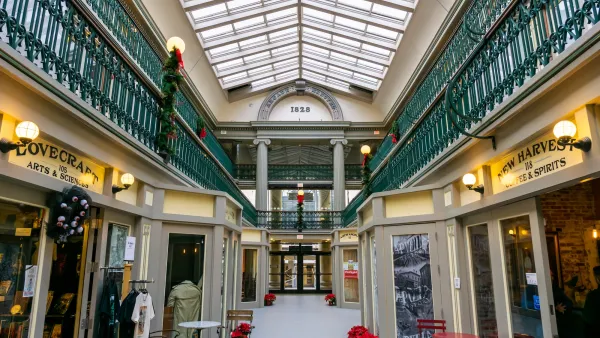
You Can Live Inside America’s Oldest Indoor Shopping Mall
The Arcade in Providence, Rhode Island, first built in 1828, was redeveloped into 48 micro-housing units.
Modular Housing for Homeless in San Francisco Hits Roadblocks
Lego-type housing construction has attracted the attention of two separate developers as an efficient means to provide housing for the city's large homeless population but has met objections from labor unions and the Mayor's Office.

Planetizen Federal Action Tracker
A weekly monitor of how Trump’s orders and actions are impacting planners and planning in America.

Washington state to charge fee to drivers with fuel-efficient cars
Revenue from the fee will go towards supporting the state’s highways.

Illinois considers spending $1 billion in taxpayer money on data center
A quantum computing campus and data center are currently under construction in Chicago.

People Mover delayed again, LAX and contractor trade barbs
The automated train was last slated to open in January 2027.

Trump to blast ‘hydrocarbon highway’ through ‘world’s longest art gallery’
Environmental and historic preservation groups are suing to stop the project.

25 states cast bids to be the home of U.S. Space Academy
The academy will train scientists, officers and astronauts for the U.S. Space Force.

FREE Course: Walkable City 1: Why Walkability?
After describing his path towards focusing on walkability as the essence of good planning, Jeff Speck marches through his five principal reasons for making more walkable places.
Reinventing Malls: Planning Alchemy—Turning Gray Fields Into Gold
The course focuses on the opportunities and imperatives that shape reinvention of mall sites.

City of Charlotte
City of Rosemead
Rutgers University, Edward J. Bloustein School of Planning and Public Policy
University of Michigan School for Environment and Sustainability (SEAS)
Hunter College, City University of New York (CUNY)
The Architects Foundation
University District Partnership