Former Treasury Secretary LaHood made distracted driving a pet cause. The dangers of walking and texting are well documented. But would could straphangers have to fear from smartphones? Plenty, as the death of a S.F. Muni rider illustrates.


Vivian Ho writes about a disturbing fatality on a crowded Muni train in San Francisco on Sept. 23. The light rail car was packed with passengers so engrossed with their smart phones and tablets that they demonstrated "collective inattention to imminent danger". One passenger in the car had wielded a .45-caliber pistol - waving it visibly - and no one noticed until the gunman fired his weapon, killing 20-year-old Justin Valdez, a San Francisco State University student, as he exited the train "in an apparently random encounter."
The scene was captured on video - not from a passenger's smart phone but from the security camera in the Muni car.
"These weren't concealed movements - the gun is very clear," said District Attorney George Gascón. "These people are in very close proximity with him, and nobody sees this. They're just so engrossed, texting and reading and whatnot. They're completely oblivious of their surroundings."
Ho interviews "Jack Nasar, an Ohio State University professor in city and regional planning who specializes in environmental psychology."
When you used to go into a public place, you assumed everyone was in that place with you," said Nasar. "What happens to public places when everybody is talking on a cell phone? Everyone is somewhere else. Someone can take a gun, hold it up, and nobody will notice it."
Nasar describes the cell phone distraction by walkers and, illustrated by the Valdez murder, transit riders as "missing the cues" that "mimicked the findings of studies of distracted driving."
The San Francisco State police offer a simple recommendation: "pull out cell phones less, pay attention more."
Read the full story: Absorbed device users oblivious to danger

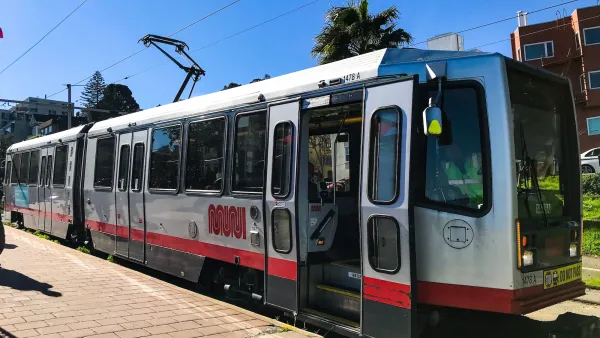
San Francisco cyclists push to allow bikes on Muni trains
The agency is one of few that bans bikes from its trains due to space constraints.

A San Francisco bus that serves thousands of students students is getting some upgrades
Students advocated for changes on the #29 bus, which was notorious for its lack of reliability.
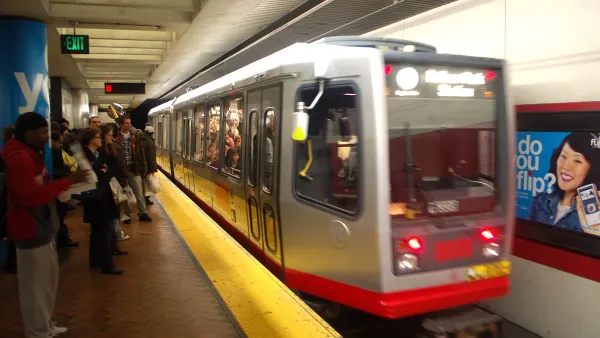
California Revives $750M Loan to Save Bay Area Transit
The state approved a $750 million loan as a stopgap measure to fund regional transit agencies until a 2026 ballot measure that could bring more permanent funding.

Planetizen Federal Action Tracker
A weekly monitor of how Trump’s orders and actions are impacting planners and planning in America.

Amtrak, CN end decades-long dispute with eight-year agreement
The new operating agreement establishes an updated framework for the companies to work together, including processes to resolve disputes.

Judges permit Denver to divert 77,000 acre feet from the Colorado River for reservoir expansion
Overuse and climate change have caused the Colorado River’s water levels to plummet.

NYC DOT wants faster, more permanent street upgrades
The city is examining ways to build more concrete infrastructure without getting entangled in 'decades-long' projects.

'Something we’ve never seen before:' rising utility rates could strain city finances nationwide
Data centers, climate change and other factors have caused utility rates in the United States to increase by 38% since 2020.

Trump to overrule local leaders, lease millions of acres of America’s Pacific Island territories’ seafloors to mining companies
International law says that the Indigenous people of America’s territories have a right to prior and informed consent regarding projects that impact their countries.

FREE Course: Walkable City 1: Why Walkability?
After describing his path towards focusing on walkability as the essence of good planning, Jeff Speck marches through his five principal reasons for making more walkable places.
Reinventing Malls: Planning Alchemy—Turning Gray Fields Into Gold
The course focuses on the opportunities and imperatives that shape reinvention of mall sites.

Harvard University Graduate School of Design
KFH Group Inc.
Greater Baltimore Committee
The Architects Foundation
University of Cincinnati Online
The Pocatello Development Authority
The Urban Renewal Agency of the City of Pocatello