Following up on their acclaimed guide to D.C., the American Society of Landscape Architects (ASLA) has published the "Landscape Architect’s Guide to Boston". Go beyond the Freedom Trail and discover what makes Boston a long-time urban innovator.


"Twelve million people visit Boston annually, but most of those visitors possess only a rudimentary knowledge of the city’s landscapes and restrict their travel to the well-established tourist routes," writes Jared Green. "With a tap of their smartphones, people can deepen their knowledge through expert commentary and more than 1,100 photos provided by 28 landscape architects."
"Thomas R. Tavella, FASLA, president of ASLA, says that the guide is the first-ever website that describes 100 historic, modern and contemporary landscapes in Boston, Cambridge and Brookline—and explains why they captivate."
“This guide will answer questions you didn’t know you had about your favorite neighborhood parks and other landscapes,” says Tavella. “Boston’s vibrant public realm didn’t just magically appear but was carefully designed over the years, and is continually evolving, through interactions among elected leaders, communities and landscape architects.”
Read the full story: Introducing The Landscape Architect’s Guide to Boston

130 Years on, Boston's Emerald Necklace Still a Model Linear Park
Writer Kaid Benfield used a recent trip the American Society of Landscape Architects annual meeting in Boston to reflect on what that city can teach us about designing urban parks.
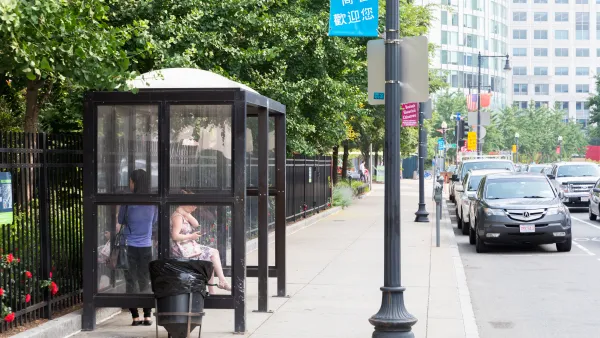
Boston requests proposals for new street furniture program
The city is looking to expand its network of bus shelters, wayfinding kiosks and other infrastructure.

Does every planner need an AI policy?
From a hundred-person agency to a one-person consultancy, the answer is yes. The difference is what “policy" means.

Planetizen Federal Action Tracker
A weekly monitor of how Trump’s orders and actions are impacting planners and planning in America.

The state-sanctioned urbicide of Austin
People don’t kill cities. Freeways do.

Colorado’s Largest Data Center Could Rise Next to Homes — Without a Public Hearing
The proposed campus would consume 11 times the power of Denver International Airport; as it has across the country, opposition mounts.

Amtrak, CN end decades-long dispute with eight-year agreement
The new operating agreement establishes an updated framework for the companies to work together, including processes to resolve disputes.

Raised interest rates may kill financially vulnerable construction projects
The chief economist at ConstructConnect warns that if construction project owners are negatively impacted by the raised rates, it could result in delayed payments to contractors.

Data centers are consuming nearly 25% of Oregon’s power
The state has 111 data centers, with 32 more either planned or under construction.

FREE Course: Walkable City 1: Why Walkability?
After describing his path towards focusing on walkability as the essence of good planning, Jeff Speck marches through his five principal reasons for making more walkable places.
Reinventing Malls: Planning Alchemy—Turning Gray Fields Into Gold
The course focuses on the opportunities and imperatives that shape reinvention of mall sites.

Greater Baltimore Committee
Eagle County Government
Harvard University Graduate School of Design
The Architects Foundation
University of Cincinnati Online
The Pocatello Development Authority
The Urban Renewal Agency of the City of Pocatello
Journal of the American Planning Association