Rick Poynor composes a photo essay that documents compelling street art found along his recent travels in Portugal and Spain. For Poyner, its not the wall-filling murals that interest him, but rather 'collectively composed street marking'.


"The street art that grabs me, if street art is even the right term, is much looser and messier than [wall-filling pictures, aerosol graffiti, or 'sub-Banksy intervention']." says Poyner. "It’s less a resolved image with a clearly stated intention and definite physical boundaries, and more a sprawling, evolving process of layering and accretion. It’s often the work, over time, of multiple hands, most likely to be anonymous....The most seductive embellishments draw out and celebrate the vital texture of the streetscape and they don’t need to be big or commanding to do this."
"For me, the pleasure of looking at this type of street communication or babbling urban unconscious (take your pick), wherever I happen to be, is closely connected to the pleasure of transforming it into a picture. If street artists and graffiti writers can appropriate parts of public space for their own purposes, then the itinerant viewer with a camera is just as free to appropriate their interventions, edit them, recompose them, find new possibilities in them, confer an alternative visual order, and turn the source material into self-contained images for equally personal purposes."
Read the full story: The Incidental Pleasures of Street Art
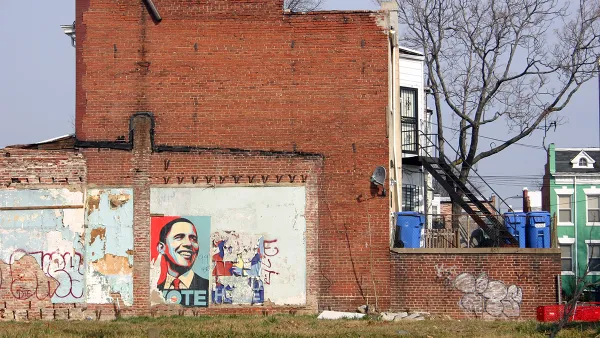
Street Artist Shepard Fairey Tackles Detroit
After billionaire landlord Dan Gilbert commissioned a mural, less-legal works in Fairey's style began showing up around the city. Detroit's case against the artist brings gentrification's ironies into focus.
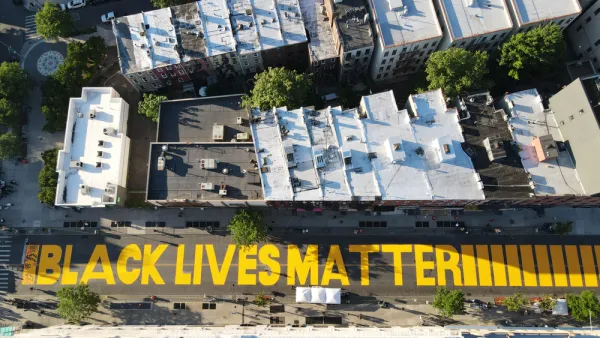
Street Art Proves the Value of Public Space
Murals do more than bring joy to onlookers. Public art can also be a source of healing, a point of reflection, and a cause for conversation.
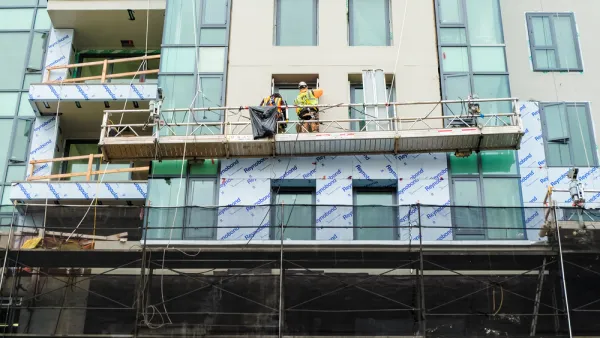
Art May Be Coming to New York City Sidewalk Sheds
Scaffolding and sidewalk sheds being a fixture of life in NYC, the city has decided to let artists do their thing with all that blank canvas.

Planetizen Federal Action Tracker
A weekly monitor of how Trump’s orders and actions are impacting planners and planning in America.

California plans to bury El Niño’s downpour
If the state plays its cards right, it may be able to store a billion acre-feet of El Niño’s water in aquifers.

Desperate measures: Advocates weigh draining Lake Powell to fill Colorado River
Draining the reservoir could reduce evaporation losses by a couple hundred thousand acre-feet.

Housing is the top priority of Seattle’s sole new councilmember
Jenks campaigned on building 1,000 new units of affordable housing.

New tax cuts may slash $1.5 billion in funding for Miami transit, public parks
Amendment 3 will save Miami-Dade homeowners $2,700 in 2028.

Arizona, Wisconsin, Pennsylvania hope to finally advance climate goals post-midterms
The three states have spent years under Republican or divided control.

FREE Course: Walkable City 1: Why Walkability?
After describing his path towards focusing on walkability as the essence of good planning, Jeff Speck marches through his five principal reasons for making more walkable places.
Reinventing Malls: Planning Alchemy—Turning Gray Fields Into Gold
The course focuses on the opportunities and imperatives that shape reinvention of mall sites.

City of Rosemead
Rutgers University, Edward J. Bloustein School of Planning and Public Policy
One Hundred Miles
University of Michigan School for Environment and Sustainability (SEAS)
Hunter College, City University of New York (CUNY)
The Architects Foundation
City of Cambridge
Montrose County
The Pocatello Development Authority