Over the last several years, successive books and exhibitions have sought to paint America's midcentury master builders in a new light, by focusing on their accomplishments. What can we learn from the 'post-war planning titans'?


"Until recently, the imperious midcentury planners were invariably cast as bullies, who steamrolled heroic community types and flattened living neighborhoods," writes Inga Saffron. "Not anymore." A new biography of Philadelphia master planner Edmund Bacon by Gregory L. Heller, "is actually the latest salvo in a campaign that seeks to restore the reputations of the post-war planning titans by casting them as can-do public servants who made hard decisions for the greater good."
Saffron traces the rehabilitation effort to the 2007 reframing of Robert Moses's legacy by Columbia University historians Hilary Ballon and Kenneth T. Jackson. "The growing respect for Moses and Bacon no doubt resonates with a public in shock and awe over China’s warp-speed transformation into a humming, twenty-first century megalopolis," she observes.
"Books like Heller’s biography of Bacon offer important insights on how to get these big projects done," concludes Saffron. "But as much as we may envy China’s efficiency, we only have to look to the Turkey, and the battle over the future of Gezi Park, to remind ourselves that the old top-down model won’t fly in a democracy. Our best hope may be to demand a form of planning where the new, independent master builders and a still-skittish citizenry can work together as equal partners. "
Read the full story: Robert Moses Redux Our new infatuation with old urban titans

How to Win at the 'Planning Game'
Julia Vitullo-Martin reviews Alexander Garvin's new book, "The Planning Game," which examines four case studies for lessons on how shrewd investments in the public realm can revitalize a city.
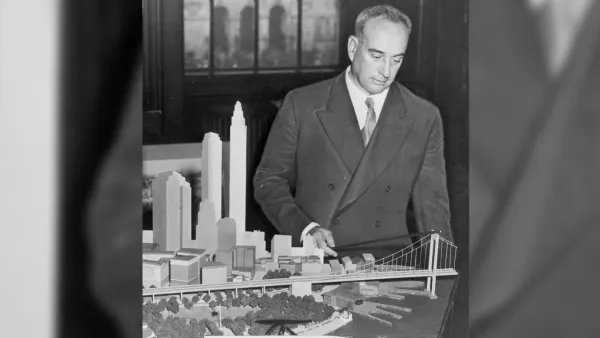
We are Perfectly Poised for Another Robert Moses
When “America is Building Again” while decentering equity, the ghost of Robert Moses haunts us.
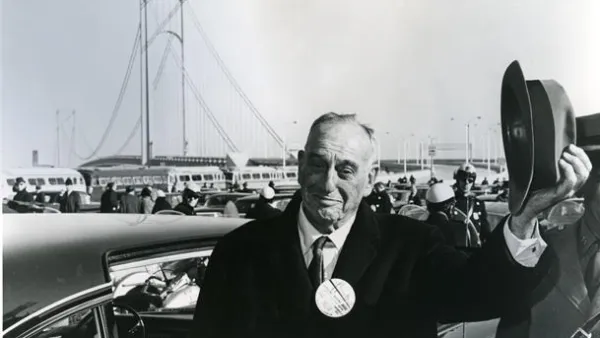
Robert Moses Takes to the Stage in 'Straight Line Crazy,' Starring Ralph Fiennes
The popular fascination with Robert Moses, "master builder of New York" and one of the most prominent figures in planning history, continues.

Planetizen Federal Action Tracker
A weekly monitor of how Trump’s orders and actions are impacting planners and planning in America.

Amtrak, CN end decades-long dispute with eight-year agreement
The new operating agreement establishes an updated framework for the companies to work together, including processes to resolve disputes.

Judges permit Denver to divert 77,000 acre feet from the Colorado River for reservoir expansion
Overuse and climate change have caused the Colorado River’s water levels to plummet.

NYC DOT wants faster, more permanent street upgrades
The city is examining ways to build more concrete infrastructure without getting entangled in 'decades-long' projects.

'Something we’ve never seen before:' rising utility rates could strain city finances nationwide
Data centers, climate change and other factors have caused utility rates in the United States to increase by 38% since 2020.

Trump to overrule local leaders, lease millions of acres of America’s Pacific Island territories’ seafloors to mining companies
International law says that the Indigenous people of America’s territories have a right to prior and informed consent regarding projects that impact their countries.

FREE Course: Walkable City 1: Why Walkability?
After describing his path towards focusing on walkability as the essence of good planning, Jeff Speck marches through his five principal reasons for making more walkable places.
Reinventing Malls: Planning Alchemy—Turning Gray Fields Into Gold
The course focuses on the opportunities and imperatives that shape reinvention of mall sites.

Harvard University Graduate School of Design
KFH Group Inc.
Greater Baltimore Committee
The Architects Foundation
University of Cincinnati Online
The Pocatello Development Authority
The Urban Renewal Agency of the City of Pocatello