For nearly a decade, the City of New York has sought to build Willoughby Square, a marquee public space in downtown Brooklyn. Thanks to a city-brokered agreement, a 'high-tech, mammoth underground garage' will help finance construction of the square.


According to Julie Satow, the planned Willoughby Square, "the long-awaited public space that New York City officials consider Brooklyn’s answer to Bryant Park in Midtown Manhattan...will span more than an acre on Willoughby Street, a half-block from the Fulton Street mall, with manicured lawns, walkways and gardens, as well as a site to commemorate the abolitionist movement."
Below the square, the Willoughby Operating Company will construct the largest automated parking facility in North America, thanks to a deal negotiated by the city. "The Willoughby Operating Company, an affiliate of the American Development Group, will lease the city-owned land," explains Satow. "It will use $6 million from city capital, the city’s Economic Development Corporation and private contributions from surrounding developers to construct the park."
"The city hopes to open the park in 2016."
Read the full story: Buried Garage to Help Pay for New Park in Brooklyn
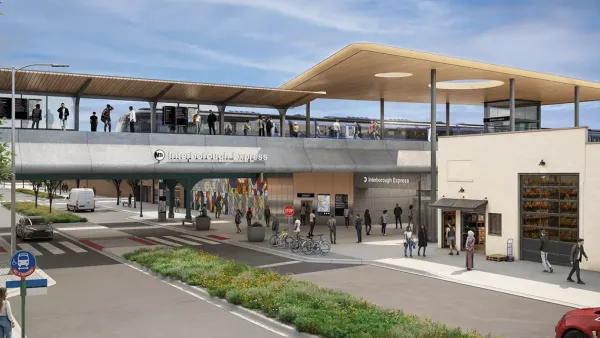
NYC releases new renderings for $5.5 billion Interborough Express
The slated stations will have a modern look, enhanced lighting and improved audio announcements.
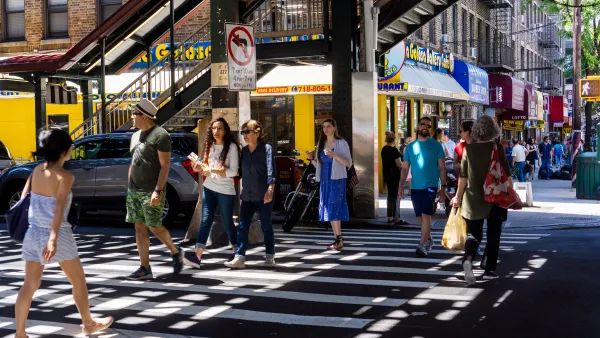
NYC needs 700,000 new homes to resolve housing crisis, report states
The report gave every neighborhood a non-binding development target.
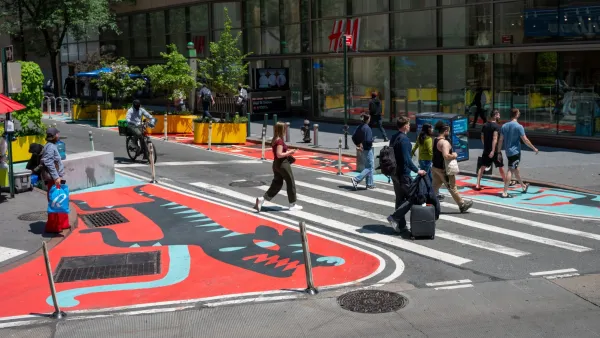
See Downtown Brooklyn’s Dramatic Complete Streets Transformation
A streetscape redesign spearheaded by the Downtown Brooklyn Partnership has quickly made many of Brooklyn’s streets unrecognizable.

Planetizen Federal Action Tracker
A weekly monitor of how Trump’s orders and actions are impacting planners and planning in America.

California plans to bury El Niño’s downpour
If the state plays its cards right, it may be able to store a billion acre-feet of El Niño’s water in aquifers.

Desperate measures: Advocates weigh draining Lake Powell to fill Colorado River
Draining the reservoir could reduce evaporation losses by a couple hundred thousand acre-feet.

Los Angeles just elected an urban planner as its mayor
Transportation analysts are optimistic that Raman will be more aggressive in addressing transit issues than Bass.

Mamdani’s pied-à-terre tax survives legal challenge
A panel of judges found that the plaintiffs failed to demonstrate injury as a result of New York City's implementation of the tax.

Eastern Nebraska is running out of electricity
Data centers and electrification are straining eastern Nebraska’s grid, throttling economic development.

FREE Course: Walkable City 1: Why Walkability?
After describing his path towards focusing on walkability as the essence of good planning, Jeff Speck marches through his five principal reasons for making more walkable places.
Reinventing Malls: Planning Alchemy—Turning Gray Fields Into Gold
The course focuses on the opportunities and imperatives that shape reinvention of mall sites.

City of Rosemead
Rutgers University, Edward J. Bloustein School of Planning and Public Policy
One Hundred Miles
University of Michigan School for Environment and Sustainability (SEAS)
Hunter College, City University of New York (CUNY)
The Architects Foundation
City of Cambridge
Montrose County
The Pocatello Development Authority