In the aftermath of Hurricane Sandy, NYC's rail system was up and running again fairly quickly, with only 19 of its rail cars damaged by the storm. By comparison, hundreds of New Jersey Transit's rail cars were damaged and months of delays ensued.


The results of a months-long investigation by WNYC/New Jersey Public Radio and The Record reveal the widly divergent ways in which New York’s Metropolitan Transportation Authority and New Jersey Transit planned for, and responded to, Hurricane Sandy.
Among the investigation's findings: "the fate of NJ Transit’s trains – over a quarter of the agency’s fleet - didn’t just hang on one set of wrong inputs. It followed years of missed warnings, failures to plan, and lack of coordination under Governor Chris Christie, who has expressed ambivalence about preparing for climate change while repeatedly warning New Jerseyans not to underestimate the dangers of severe storms."
"Official response to this blunder has largely stuck to one script: No one could have predicted the severity of the storm, and the yards had never flooded before," report Kate Hinds and Andrea Bernstein. "But NJ Transit’s miscalculations came even as New York’s Metropolitan Transportation Authority dived into climate change adaptation preparations."
Read the full story: How New Jersey Transit Failed Sandy's Test
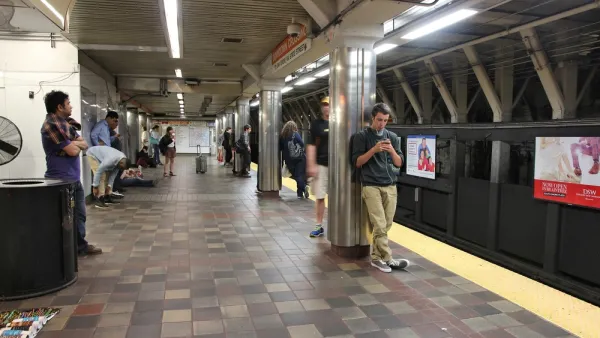
The Sad Saga of Three East Coast Subways
With so much attention placed on the woes facing D.C. Metro, it's important to recognize that it is hardly the only subway facing critical infrastructure investment needs.
Three Days of Delays on Northeast Corridor for Amtrak and NJ Transit
Once again, chronic delays on New Jersey Transit's rail lines in and out of Manhattan serve as a reminder of Gov. Christie's ill fated decision to cancel replacement of the two aging Hudson River tunnels to Penn Station.
The Return of the Ferry to the Big Apple—to All Five Boroughs
Ferries, New York City's first commuter mode, will return big-time if Mayor Bill de Blasio gets his way. Judging by how well the proposal in his February 3 State of the City address was received, he will.

Planetizen Federal Action Tracker
A weekly monitor of how Trump’s orders and actions are impacting planners and planning in America.

California plans to bury El Niño’s downpour
If the state plays its cards right, it may be able to store a billion acre-feet of El Niño’s water in aquifers.

Desperate measures: Advocates weigh draining Lake Powell to fill Colorado River
Draining the reservoir could reduce evaporation losses by a couple hundred thousand acre-feet.

Los Angeles just elected an urban planner as its mayor
Transportation analysts are optimistic that Raman will be more aggressive in addressing transit issues than Bass.

Mamdani’s pied-à-terre tax survives legal challenge
A panel of judges found that the plaintiffs failed to demonstrate injury as a result of New York City's implementation of the tax.

Eastern Nebraska is running out of electricity
Data centers and electrification are straining eastern Nebraska’s grid, throttling economic development.

FREE Course: Walkable City 1: Why Walkability?
After describing his path towards focusing on walkability as the essence of good planning, Jeff Speck marches through his five principal reasons for making more walkable places.
Reinventing Malls: Planning Alchemy—Turning Gray Fields Into Gold
The course focuses on the opportunities and imperatives that shape reinvention of mall sites.

City of Rosemead
Rutgers University, Edward J. Bloustein School of Planning and Public Policy
One Hundred Miles
University of Michigan School for Environment and Sustainability (SEAS)
Hunter College, City University of New York (CUNY)
The Architects Foundation
City of Cambridge
Montrose County
The Pocatello Development Authority