Expanding car and bike share services beyond America's big cities and affluent demographics requires adaptability and old economy technologies. Buffalo CarShare is providing a model for success that even the big boys could learn from.


Angie Schmitt profiles Buffalo CarShare, a non-profit organization that is "working to open up car-share to new markets and new demographics." Launched four years ago with a grant from the New York State Energy Research and Development Authority and NYSDOT, the program now has 500 members.
"Buffalo CarShare is able to reach people with low incomes primarily because — in contrast to Zipcar — it is willing to serve customers face-to-face or through the mail, if need be, [co-founder and executive director Creighton Randall] says. The business operates out of a transit-accessible storefront near the city center — and many of its customers are walk-ins," explains Schmitt. "The organization is also willing to send out bills by mail, or accept money orders. Its 14 cars are sited at 12 different locations across the city."
Next on the organization's agenda is the establishment of a bike share program to serve the residents of what is one of the poorest cities in the country. "They hope the lower initial costs of this system can help make bike-share more accessible to people with a variety of income levels as well," says Schmitt.
Read the full story: Expanding Car-Share Beyond America’s Biggest Cities

Insurance Regulations Threaten Buffalo's Affordable Car Share Program
The $200,000 non-profit Buffalo CarShare program offer people living in poverty a low-cost option for short-term rentals of cars. Despite state support for the program, state insurance regulations might end it.
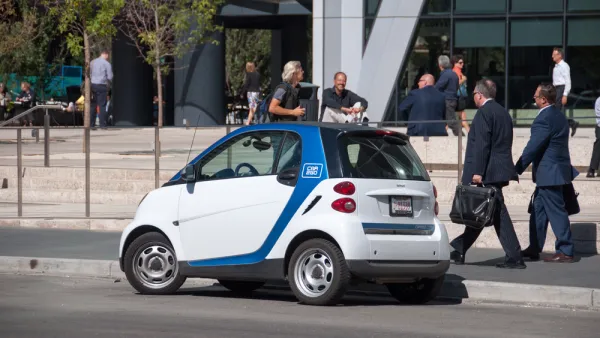
Opinion: Boost Public Car Share to Reduce Private Vehicle Ownership
Research shows that consistent access to shared cars drastically reduces car ownership rates, but U.S. regulations often impede success for private fleets.
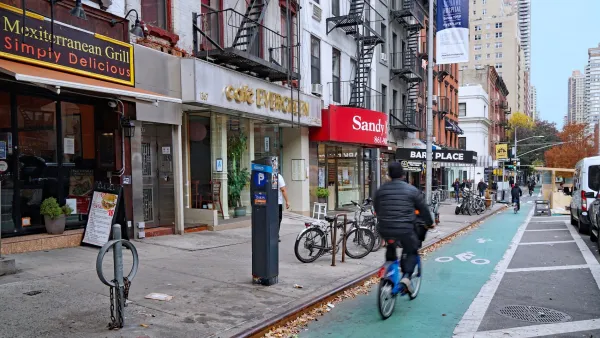
Study: Protected bike lanes increase Citi Bike rides by nearly 400 rides a month
An analysis of millions of NYC bike share rides reveals that only protected bike lanes have a 'statistically significant' increase in ridership.

Planetizen Federal Action Tracker
A weekly monitor of how Trump’s orders and actions are impacting planners and planning in America.

California plans to bury El Niño’s downpour
If the state plays its cards right, it may be able to store a billion acre-feet of El Niño’s water in aquifers.

Chicago breaks ground on $3 billion megadevelopment
The new neighborhood, titled Foundry Park, will one day host 3,700 residences.

California High-Speed Rail Authority CEO resigns after $600,000 scandal
Under Ian Choudri, the authority used taxpayer dollars to fund first class flights and trips to nightclubs.

Want to study the Missouri River? Soon, you may need unanimous approval from 10 states
Legislation would require 10 governors’ permission to study or build projects moving water outside the basin.

Desperate measures: Advocates weigh draining Lake Powell to fill Colorado River
Draining the reservoir could reduce evaporation losses by a couple hundred thousand acre-feet.

FREE Course: Walkable City 1: Why Walkability?
After describing his path towards focusing on walkability as the essence of good planning, Jeff Speck marches through his five principal reasons for making more walkable places.
Reinventing Malls: Planning Alchemy—Turning Gray Fields Into Gold
The course focuses on the opportunities and imperatives that shape reinvention of mall sites.

City of Rosemead
Rutgers University, Edward J. Bloustein School of Planning and Public Policy
One Hundred Miles
Hunter College, City University of New York (CUNY)
The Architects Foundation
University of Cincinnati Online
City of Cambridge
Montrose County
The Pocatello Development Authority