Mark Andrew Boyer looks at the work of San Francisco's "municipal cart auditors" a team of city employed trash diggers who scour the city's cans for scofflaw sorters as part of a broader effort to become 100-percent "waste-free" by 2020.


Boyer tags along with James Slattery, an assistant coordinator with the city's Department of Environment who heads "San Francisco's first-of-its-kind trash monitoring and neighborhood outreach program."
"To help improve the city's landfill diversion rate, Slattery and his crew pound the pavement, both in the early morning and in the evening, keeping tabs on what's being thrown out and educating people about the three-bin system," writes Boyer. "The early-morning cart monitors are armed with clipboards, and they take notes about the trash sorting behavior of each household, which is later entered into a database and given to the outreach crew."
"'Bad, bad, bad,' says [Nora] Calderon [on of Slattery's colleagues], shaking her head as she peered into the bins in front of a small home. 'This goes in here,' she says, pointing to pieces of plastic packaging that had been put in the black bin instead of the blue recycling bin. She makes a note of it and moves to the next house. There's no time to waste, because it's garbage day, and the crew has to remain a few blocks ahead of the trash collectors."
Read the full story: San Francisco's Trash Inspectors Get Up Earlier Than You Do
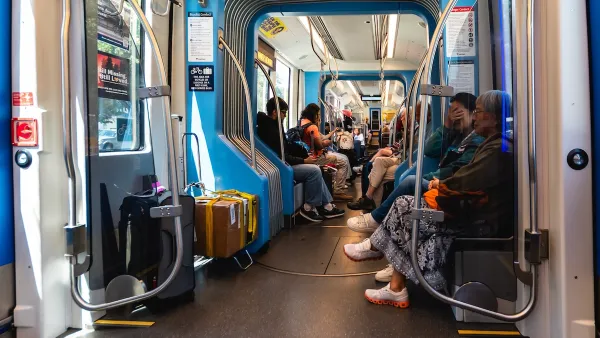
Voters choose public transit, approve $31 billion in funding
Approved projects include $101,000 for reduced-cost transit in a Michigan town and $14 billion for regional transit in the San Francisco Bay Area.

Bay area voters pass ‘crucial lifeline’ for transit
Proposition RTM, which will fund Bay Area transit, has approval from 61% of voters as of 9:45 p.m. on Nov. 3.

California High-Speed Rail Authority picks trainset manufacturer
The California High-Speed Rail Authority aims to start servicing passengers by 2033.

Desperate measures: Advocates weigh draining Lake Powell to fill Colorado River
Draining the reservoir could reduce evaporation losses by a couple hundred thousand acre-feet.

Eastern Nebraska is running out of electricity
Data centers and electrification are straining eastern Nebraska’s grid, throttling economic development.

Move over, LA: St. Louis gears up for Olympics, invests millions in downtown redevelopment
The Missouri city will host the 2028 Olympic soccer group stage and knockout matches.

Mass. votes against statewide minimum lot size for single-family homes
Over 2 million residents voted on Question 7; it was decided by just over 30,000 votes.

Maryland’s $15 billion bridge project gains key approval
The Maryland Transit Authority said the project will create over 60,000 jobs and add $23 billion to the local economy.

‘No clear next steps’ for Chicago's permanent festival grounds
Eleventh Ward Ald. Nicole Lee has suggested Soldier Field as a possible location for the permanent event space.

FREE Course: Walkable City 1: Why Walkability?
After describing his path towards focusing on walkability as the essence of good planning, Jeff Speck marches through his five principal reasons for making more walkable places.
Reinventing Malls: Planning Alchemy—Turning Gray Fields Into Gold
The course focuses on the opportunities and imperatives that shape reinvention of mall sites.

City of Rosemead
Rutgers University, Edward J. Bloustein School of Planning and Public Policy
One Hundred Miles
University of Michigan School for Environment and Sustainability (SEAS)
Hunter College, City University of New York (CUNY)
The Architects Foundation
City of Cambridge
Montrose County
The Pocatello Development Authority