The opening of a half-mile trail along the Los Angeles River, after a decade of funding and construction snags, marks the latest step in the city's effort to reclaim its forsaken river as a public resource.


reports on the opening of the $2.1 million first phase of the Glendale Narrows Riverwalk project, which, in addition to the trail, includes horse facilities and park areas. The project is just a small part of what many hope will be a multi-billion dollar makeover of the river. Yet small steps like this may be essential to get residents and leaders on board with the ambitious idea that an oversized drainage ditch can be transformed into a recreational hub, ecological asset, and an engine for economic development.
"Along the trail, the sounds of the river mix with traffic whirring by along the 5 Freeway above. Interpretive signs and drought-resistant plants line the paved trail on both sides, yet graffiti remains under the overpass," observes Levine. "Despite the vandalism, the changes are a major upgrade, parkgoers said. Neighbors described the area before the new trail and park areas were installed as 'trash' and 'Godforsaken.' Now, they use words like 'beautiful' and 'magnificent.'"
"'From what it was, it's a huge improvement,' said Rachel Torres, a Glendale resident who was excited to walk her dog, Luke, near the river. When the third phase is complete, she envisioned taking the Great Dane/Shar-Pei mix over to Griffith Park."
"'It's really a battle to get on your bike in L.A.,' said Glendale resident Joan Hardie as she sat on her turquoise bicycle with a woven basket. 'It's nice to have a little oasis like this.'"
Read the full story: First phase of Glendale Narrows Riverwalk opens
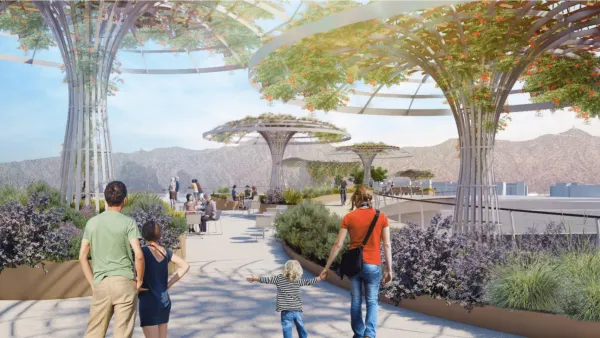
'Transformative' pedestrian bridge planned for LA River in Glendale Narrows
A new bridge will link Griffith Park and the Glendale Narrows Riverwalk.
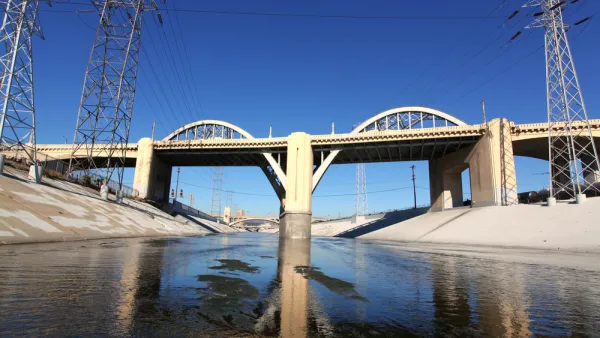
Designing Safe Passage for Steelhead Trout Through the L.A. River
The Southern California steelhead was added to the federal endangered species list in 1997. Today, planners are working to create a new home for the trout in the L.A. River.
A Bold Housing Vision for the L.A. River
An unsolicited proposal from the engineering firm reimagines a stretch along the L.A. River as a mixed-use mega-development, rich in housing and jobs.

Planetizen Federal Action Tracker
A weekly monitor of how Trump’s orders and actions are impacting planners and planning in America.

California plans to bury El Niño’s downpour
If the state plays its cards right, it may be able to store a billion acre-feet of El Niño’s water in aquifers.

Desperate measures: Advocates weigh draining Lake Powell to fill Colorado River
Draining the reservoir could reduce evaporation losses by a couple hundred thousand acre-feet.

Mamdani’s pied-à-terre tax survives legal challenge
A panel of judges found that the plaintiffs failed to demonstrate injury as a result of New York City's implementation of the tax.

Eastern Nebraska is running out of electricity
Data centers and electrification are straining eastern Nebraska’s grid, throttling economic development.

Seattle passes record-breaking transit services expansion
Proposition 1 will double the city’s transit tax to add 95,000 more bus trips and preserve 180,000 bus trips annually.

FREE Course: Walkable City 1: Why Walkability?
After describing his path towards focusing on walkability as the essence of good planning, Jeff Speck marches through his five principal reasons for making more walkable places.
Reinventing Malls: Planning Alchemy—Turning Gray Fields Into Gold
The course focuses on the opportunities and imperatives that shape reinvention of mall sites.

City of Rosemead
Rutgers University, Edward J. Bloustein School of Planning and Public Policy
One Hundred Miles
University of Michigan School for Environment and Sustainability (SEAS)
Hunter College, City University of New York (CUNY)
The Architects Foundation
City of Cambridge
Montrose County
The Pocatello Development Authority