Eric Pryne reports on the online giant's unprecedented impact on Seattle's physical and real estate landscapes, as the company's "breathtaking" growth rejuvenates the downtown office market.


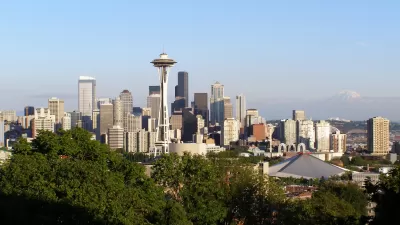
"Amazon is the undisputed heavyweight champion of downtown Seattle," says Kip Spencer, president of The Spencer Companies, a Seattle real-estate consulting firm. With two gigantic real estate deals announced over the past year, including plans for downtown Seattle's biggest ever development and the purchase of its South Lake Union headquarters for $1.16 billion (together comprising 5.1 million-square-feet of office space), the virtual giant has cemented its place as "the colossus of Seattle real estate," writes Pryne.
"In the 25 or 30 years I've been around downtown Seattle, I've never seen anything remotely like what Amazon has done to the market," says Dale Sperling, former president and CEO of Seattle's Unico Properties.
"Amazon's breathtaking growth — it has moved into about 2.7 million square feet in South Lake Union and the Denny Triangle since spring 2010 — has spearheaded the downtown office market's recovery from record-high vacancy rates brought on by the recession and Washington Mutual's demise," notes Pryne. "The company's contrarian decision to locate downtown could spur more tech and Internet companies to move in from the suburbs, Downtown Seattle Association President Kate Joncas says."
And the company's oversized impact isn't just limited to the commercial real estate market. "Their arrival has helped ignite the city's biggest apartment-construction boom in at least 20 years," says Pryne. "Owners and developers of apartment buildings, condo towers, hotels and retail space are cashing in on the company's growth as well."
"Amazon uses their urban campus and the in-city lifestyle as an effective recruiting tool," says Dean Jones of brokerage Realogics Sotheby's International Realty, "and that's good for downtown housing."
"They're driving urbanization," Sperling adds. "These kids are all urban dwellers."
Read the full story: Amazon puts its stamp on downtown Seattle
Risky Business: Speculating on the Future of Location of Amazon's HQ2
Real estate investors are willing to gamble on the potential of the future location, still to be determined, of Amazon's second headquarters.
Amazon's First Forays Into Homebuilding Are Worth Watching
A new player with a very familiar name has entered into the residential homebuilding market.
Study Predicts the 'Amazon Effect' of HQ2 on Rents
Spoiler alert: the rent will go up in whatever city Amazon chooses for the site of its second headquarters.

Planetizen Federal Action Tracker
A weekly monitor of how Trump’s orders and actions are impacting planners and planning in America.

California plans to bury El Niño’s downpour
If the state plays its cards right, it may be able to store a billion acre-feet of El Niño’s water in aquifers.

Desperate measures: Advocates weigh draining Lake Powell to fill Colorado River
Draining the reservoir could reduce evaporation losses by a couple hundred thousand acre-feet.

Chicago voters approve permanent festival grounds, penalty for vacant property owners
Currently, major summer and fall festivals take over public parks for weeks at a time, drawing criticism from nearby residents

NYC votes to cut outdoor dining red tape, speed up permitting
New York City also voted to allow the Department of Transportation to begin work on urgent projects before notifying elected officials.

California appears to reject Prop. 45
The proposition would have expanded the projects that qualify for a streamlined environmental review, effectively paring down the California Environmental Quality Act.

FREE Course: Walkable City 1: Why Walkability?
After describing his path towards focusing on walkability as the essence of good planning, Jeff Speck marches through his five principal reasons for making more walkable places.
Reinventing Malls: Planning Alchemy—Turning Gray Fields Into Gold
The course focuses on the opportunities and imperatives that shape reinvention of mall sites.

City of Rosemead
Rutgers University, Edward J. Bloustein School of Planning and Public Policy
One Hundred Miles
Hunter College, City University of New York (CUNY)
The Architects Foundation
University of Cincinnati Online
City of Cambridge
Montrose County
The Pocatello Development Authority