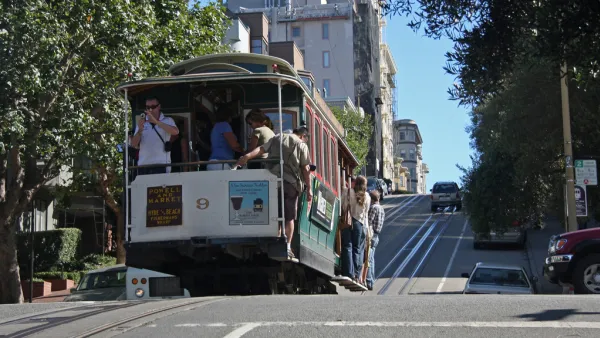
Geoff Manaugh and Nicola Twilley tour the "otherwise nondescript brick building" on San Francisco's Mason Street that houses the machines running the "Endless Wire Ropeway" that hums beneath the city's streets and pulls its famous cable cars.


The brick building at 1201 Mason Street houses the "surprisingly fantastic" San Francisco Cable Car Museum. Inside the museum, in addition to historic photographs and display cases filled with mechanical devices, one finds "a cavernous and open interior that stands all but gutted to make space for these vast winding wheels [that pull the cables] and the electric motors that drive them."
"However," say Manaugh and Twilley, "it's not until you descend into an underground viewing area to see the the spinning 'sheaves' that bring each of the four cable lines back into the building from their channels beneath the streets that the immense strangeness of the cable car system really becomes apparent."
"The fact that something so familiar and over-photographed -- in an era dominated by notions of urban software, immaterial metaphors of 'the cloud,' and the very idea of 'smart cities' -- actually operates by way of shadowy, clockwork mechanical systems so exhilaratingly titanic, analogue, and, frankly, bizarre was an astonishing thing to learn."
The best part? The museum, and its "Herculean wheels," are free and open to the public daily.
Read the full story: The Giant Underground Machinery That Runs San Francisco's Famous Cable Cars
How San Francisco Integrates Historic Rail Lines into its Transit System
San Francisco has managed to operate and integrate historic rail transit into its overall public transit system. Clement Lau explains how the City does it.
Thanks to SF's Cable Cars, Bell Tolls for City's Public Transit
They're a global icon of the City by the Bay and one of San Francisco's premier tourist attractions. Operating at a loss, the city's cable cars are also draining resources from more essential forms of public transit, writes Joe Eskenazi.
S.F.'s Market Street Railway Celebrates Sesquicentennial
Carl Nolte, the San Francisco Chronicle's historian, writes on the 150-year anniversary of the Market St. Railway that began operation as a 2-car steam train on July 4, 1860, and the evolution of rail on/under Market St including BART & Muni Metro.

Planetizen Federal Action Tracker
A weekly monitor of how Trump’s orders and actions are impacting planners and planning in America.

California plans to bury El Niño’s downpour
If the state plays its cards right, it may be able to store a billion acre-feet of El Niño’s water in aquifers.

Desperate measures: Advocates weigh draining Lake Powell to fill Colorado River
Draining the reservoir could reduce evaporation losses by a couple hundred thousand acre-feet.

Chicago voters approve permanent festival grounds, penalty for vacant property owners
Currently, major summer and fall festivals take over public parks for weeks at a time, drawing criticism from nearby residents

NYC votes to cut outdoor dining red tape, speed up permitting
New York City also voted to allow the Department of Transportation to begin work on urgent projects before notifying elected officials.

California appears to reject Prop. 45
The proposition would have expanded the projects that qualify for a streamlined environmental review, effectively paring down the California Environmental Quality Act.

FREE Course: Walkable City 1: Why Walkability?
After describing his path towards focusing on walkability as the essence of good planning, Jeff Speck marches through his five principal reasons for making more walkable places.
Reinventing Malls: Planning Alchemy—Turning Gray Fields Into Gold
The course focuses on the opportunities and imperatives that shape reinvention of mall sites.

City of Rosemead
Rutgers University, Edward J. Bloustein School of Planning and Public Policy
One Hundred Miles
Hunter College, City University of New York (CUNY)
The Architects Foundation
University of Cincinnati Online
City of Cambridge
Montrose County
The Pocatello Development Authority