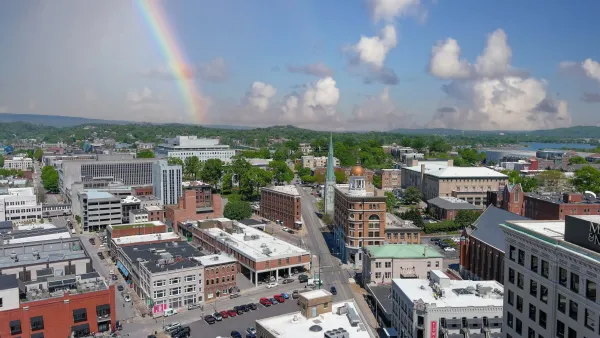
Thomas Friedman uses Chattanooga, Tenn. as an example of the "innovative thrust building, bottom-up, in the U.S. economy today." In an opinion piece for the Times, he urges leaders in Washington to help unlock America's embryonic growth surge.


Friedman points to America's cities, from Chattanooga to Minneapolis, as places where local Democrats and Republicans are coming together to invest in infrastructure, spurring innovation and job growth that could propel the country into a period of growth. The key to unlocking this growth, he says, are "a couple of grand bargains" around the issues of taxes, deficits, and investment.
"I get why the president needs to stress that the wealthy will have to pay higher taxes before he can go to his base for spending cuts to restore long-term fiscal balance," says Friedman. "But here’s what I hope we’ll see more from the president: a sense of excitement, a sense that if we can just get this grand bargain done, we can really unlock growth again, we can really, as Mohamed El-Erian, the C.E.O. of the bond giant Pimco, puts it, 'restore economic dynamism, ensure financial soundness, and overcome political dysfunction,' which collectively would have a huge stimulative effect."
"If everyone has to take their castor oil — the rich more, the middle class some — make them feel that it will enable us all to get stronger. Make them feel that we’re embarking on a new journey — not to punish but to solve, not to sock it to the successful but to create more abundance for all. Because the right mix of tax increases, spending cuts and investment incentives will spur more start-ups, lead to more risk-taking, inspire more entrepreneurship and create more jobs. Elections are win-lose, but successful negotiations are always to some degree win-win."
Fast Web and Local Food Key to Chattanooga's Revival
Through a combination of local food initiatives and the installation of a new high-speed fiber optic network, the city of Chattanooga is hoping to continue its trend of recovering from years of industrial decline.
Chattanooga selects churches to build up to 400 affordable homes
Eight churches will move forward with plans to develop housing, from emergency shelter to single-family homes, on their properties.

Planetizen Federal Action Tracker
A weekly monitor of how Trump’s orders and actions are impacting planners and planning in America.

Eastern Nebraska is running out of electricity
Data centers and electrification are straining eastern Nebraska’s grid, throttling economic development.

Move over, LA: St. Louis gears up for Olympics, invests millions in downtown redevelopment
The Missouri city will host the 2028 Olympic soccer group stage and knockout matches.

Dallas releases zoning code overhaul to officials
The drafted overhaul is over 400 pages long.

NYC renovations for dangerous, ‘mercilessly crammed’ street delayed until 2027
Construction was supposed to begin this fall.

San Diego’s Midway Rising project gets greenlight from city council
The project looks to become the largest affordable housing development in California's history.

FREE Course: Walkable City 1: Why Walkability?
After describing his path towards focusing on walkability as the essence of good planning, Jeff Speck marches through his five principal reasons for making more walkable places.
Reinventing Malls: Planning Alchemy—Turning Gray Fields Into Gold
The course focuses on the opportunities and imperatives that shape reinvention of mall sites.

City of Rosemead
Rutgers University, Edward J. Bloustein School of Planning and Public Policy
One Hundred Miles
University of Michigan School for Environment and Sustainability (SEAS)
Hunter College, City University of New York (CUNY)
The Architects Foundation
City of Cambridge
The Pocatello Development Authority
The Urban Renewal Agency of the City of Pocatello