Mick Sweetman of George Brown College criticizes Toronto city council's decision to remove an existing bike lane heavily used by that college's students.


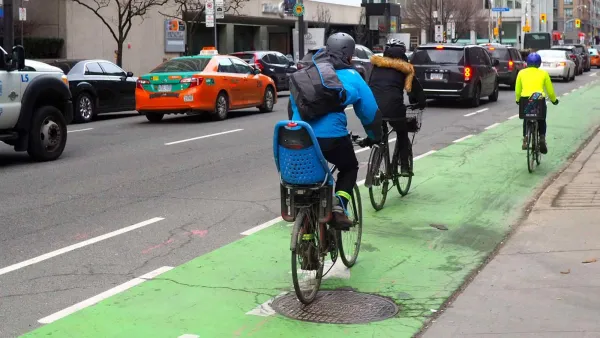
The city council dominated by Toronto Mayor Rob Ford is often criticized for its regressive decisions where transportation planning is concerned, such as de-funding the "Transit City" plan. Now council has voted to remove a bike lane in order to "speed up" motor vehicle traffic, despite warnings that council will "have blood on its hands" as a result of inevitable cyclist deaths and injuries.
"[T]he estimated time that drivers will be saving by City Council's decision to eliminate the bike lanes on Jarvis Street is two minutes. A shorter wait than the average line at Tim Hortons [coffee shop] is what your city council thinks is more important than the safety of the 1,000 cyclists that ride on Jarvis Street every day. How many of those cyclists are riding to and from George Brown College's St. James campus, which sits only 150 meters from Jarvis St.? While the construction of separated bike lanes on Sherbourne Street -- which won't be ready until 2014 and so far are little more than glorified speed bumps -- are a good addition to the...poor cycling infrastructure in this city it makes no sense to be removing bike lanes from Jarvis.
I hate to say it, but city councilor Mike Layton is right when he said that cyclists are going to die on Jarvis because of this decision. When, not if, a cyclist is injured on Jarvis Street, their blood will be on [the] hands [of Mayor Rob Ford's supporters on Council]."
Read the full story: Why ripping up bike lanes in Toronto will hurt students and cost lives

Toronto Dials Back on Bikes
While cities across North America work diligently to expand their bicycle infrastructure, Toronto appears to be headed in the opposite direction, and local bike enthusiasts are taking to the streets to voice their opposition, reports Lloyd Alter.

Ontario Judge Saves Toronto Bike Lanes
A court order bars the provincial government from removing bike lanes, saying the decision would make roads more dangerous and fail to reduce congestion.
Toronto's Expanded its Bike Infrastructure Network to Run Parallel to Transit Lines
The Toronto City Council approved a quick expansion of bike lanes around the city to provide an alternative to public transit during and after the pandemic.

Planetizen Federal Action Tracker
A weekly monitor of how Trump’s orders and actions are impacting planners and planning in America.

Colorado’s Largest Data Center Could Rise Next to Homes — Without a Public Hearing
The proposed campus would consume 11 times the power of Denver International Airport; as it has across the country, opposition mounts.

US to reduce Colorado River water deliveries to Mexico
A new Colorado Treaty amendment reduces Mexico’s Colorado River water allocation by 250,000 acre feet.

'This is going to be painful:’ Virginia stares down $1.7 billion funding gap for highway maintenance
The state may address the deficit by shifting $290 million from its construction budget to maintenance projects.

Judges permit Denver to divert 77,000 acre feet from the Colorado River for reservoir expansion
Overuse and climate change have caused the Colorado River’s water levels to plummet.

Amtrak, CN end decades-long dispute with eight-year agreement
The new operating agreement establishes an updated framework for the companies to work together, including processes to resolve disputes.

FREE Course: Walkable City 1: Why Walkability?
After describing his path towards focusing on walkability as the essence of good planning, Jeff Speck marches through his five principal reasons for making more walkable places.
Reinventing Malls: Planning Alchemy—Turning Gray Fields Into Gold
The course focuses on the opportunities and imperatives that shape reinvention of mall sites.

KFH Group Inc.
Greater Baltimore Committee
Eagle County Government
The Architects Foundation
University of Cincinnati Online
The Pocatello Development Authority
The Urban Renewal Agency of the City of Pocatello