The high-profile case of Raquel Nelson, who was arrested when her four-year-old son was killed as she attempted to cross the street with him, and another recent episode demonstrate the Atlanta region's abysmal attitude toward pedestrians.


Angie Schmitt discusses the recent case of a pedestrian struck by a car in northwest Atlanta who was charged with jaywalking; another example of the region's draconian pedestrian laws.
"Sally Flocks, director of Atlanta's pedestrian advocacy organization,
PEDS, says it is not unusual for police officers in the region to cite
and fault pedestrians involved in collisions, even as they're lying in
hospital beds," writes Schmitt.
"The sad fact is that many of Atlanta's sidewalks are in terrible condition; the city had to pay $4 million
in injury settlements last year as a result. Meanwhile, in the suburbs,
pedestrians get cited for crossing the street outside of a marked or
unmarked crosswalk."
"Even worse, despite discrimination claims around the Raquel Nelson case,
local pedestrian advocates have reason to believe the law is being
applied unevenly. Flocks said the citations tend to be concentrated in
low-income and Hispanic neighborhoods."
Read the full story: Greater Atlanta Continues to Treat Walking Like a Crime
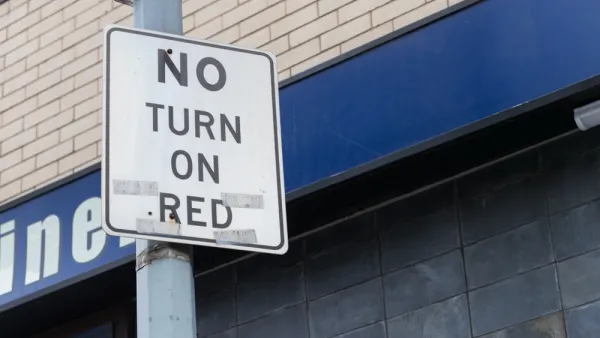
Banning Right Turns on Red: Lessons From Atlanta
How road safety activists passed a law that could make roads much safer.
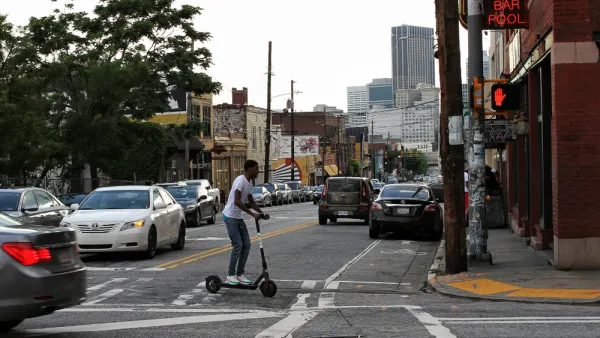
Atlanta Urges Tactical Urbanism To Speed Up Vision Zero Goals
The city's department of transportation has released a guide to help community groups implement low-cost 'tactical urbanism' projects.
Atlanta Lowers Speed Limits Citywide
Vision Zero arrives in one of the country's most car-centric big cities.

Planetizen Federal Action Tracker
A weekly monitor of how Trump’s orders and actions are impacting planners and planning in America.

California plans to bury El Niño’s downpour
If the state plays its cards right, it may be able to store a billion acre-feet of El Niño’s water in aquifers.

Desperate measures: Advocates weigh draining Lake Powell to fill Colorado River
Draining the reservoir could reduce evaporation losses by a couple hundred thousand acre-feet.

Mamdani’s pied-à-terre tax survives legal challenge
A panel of judges found that the plaintiffs failed to demonstrate injury as a result of New York City's implementation of the tax.

Eastern Nebraska is running out of electricity
Data centers and electrification are straining eastern Nebraska’s grid, throttling economic development.

Seattle passes record-breaking transit services expansion
Proposition 1 will double the city’s transit tax to add 95,000 more bus trips and preserve 180,000 bus trips annually.

FREE Course: Walkable City 1: Why Walkability?
After describing his path towards focusing on walkability as the essence of good planning, Jeff Speck marches through his five principal reasons for making more walkable places.
Reinventing Malls: Planning Alchemy—Turning Gray Fields Into Gold
The course focuses on the opportunities and imperatives that shape reinvention of mall sites.

City of Rosemead
Rutgers University, Edward J. Bloustein School of Planning and Public Policy
One Hundred Miles
University of Michigan School for Environment and Sustainability (SEAS)
Hunter College, City University of New York (CUNY)
The Architects Foundation
City of Cambridge
Montrose County
The Pocatello Development Authority