Michael Powell looks at the penalties facing drivers that strike pedestrians and cyclists in New York City, and finds depressingly few repercussions.


"In this city of walkers, where we take pride in hoofing it with such a
manic intensity that researchers often find us moving faster than
crosstown buses, striking a pedestrian - or a biker - and driving away
carries few consequences," notes Powell.
"The State Department of Motor Vehicles recorded about 3,000 serious
nonfatal accidents last year in New York City. The city Police
Department's Accident Investigation Squad investigated only 63, or 2
percent of these nonfatal serious crashes, according to the state."
Even as the city continues with one of the most ambitious pedestrian and bicycle safety campaigns in its history, "Police Commissioner Raymond W. Kelly, characteristically, claims to see
no problem. His department is state of the art; the streets get safer
all the time; pedestrian fatalities have dropped 30 percent in the past
decade."
Read the full story: Reckless Drivers Who Hit People Face Few Penalties in New York
Supposed Safe Havens Pose Danger to Pedestrians in NYC
A new study conducted by NYU's Langone Medical Center reveals that pedestrians are most often struck by cars in New York's supposed safe havens: in a crosswalk with the signal on their side. Findings related to bicycle safety were also revealed.
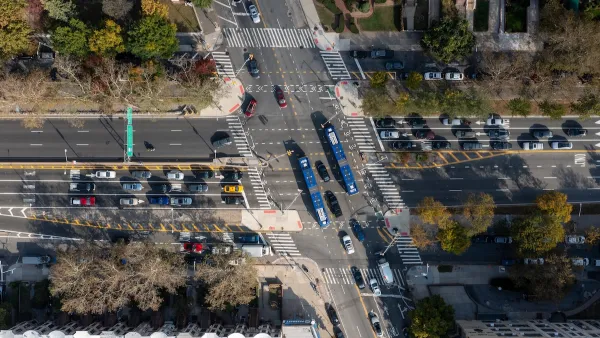
This road in NYC is infamously dangerous — and Mamdani can't fix it
New York City's Ocean Parkway is known for reckless driving, but the power to implement safety measures lies with the state rather than the city.
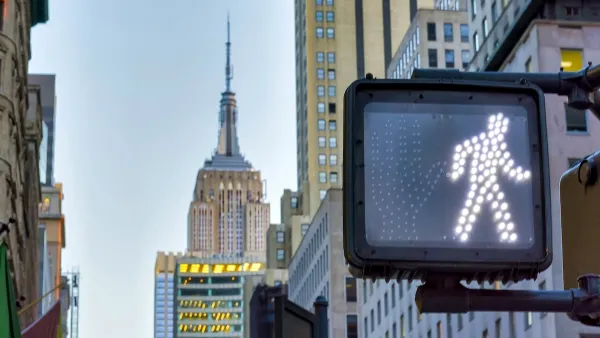
NYC Pedestrian-Focused Traffic Signals Reduce Injury Crashes by 33%
Intersections equipped with signals that give pedestrians a seven-second head start saw a marked increase in safety.

Planetizen Federal Action Tracker
A weekly monitor of how Trump’s orders and actions are impacting planners and planning in America.

California plans to bury El Niño’s downpour
If the state plays its cards right, it may be able to store a billion acre-feet of El Niño’s water in aquifers.

Desperate measures: Advocates weigh draining Lake Powell to fill Colorado River
Draining the reservoir could reduce evaporation losses by a couple hundred thousand acre-feet.

US buildings threatened, destroyed by fires set to triple by 2060
Researchers found a high fire risk for socioeconomically vulnerable neighborhoods in the American West.

LA residents may be allowed to paint their own crosswalks
Councilwoman Katy Yaroslavsky put out a motion instructing the Los Angeles Department of Public Transportation to study the feasibility of allowing volunteers to paint crosswalks.

Dallas moves to overhaul its zoning code
The city's zoning reform will allow more multi-family and mixed-use developments.

FREE Course: Walkable City 1: Why Walkability?
After describing his path towards focusing on walkability as the essence of good planning, Jeff Speck marches through his five principal reasons for making more walkable places.
Reinventing Malls: Planning Alchemy—Turning Gray Fields Into Gold
The course focuses on the opportunities and imperatives that shape reinvention of mall sites.

City of Rosemead
Rutgers University, Edward J. Bloustein School of Planning and Public Policy
One Hundred Miles
Hunter College, City University of New York (CUNY)
The Architects Foundation
University of Cincinnati Online
City of Cambridge
Montrose County
The Pocatello Development Authority