With drought conditions not seen in the U.S. since the middle of the last century, the battle to maintain the lushest lawn in the neighborhood has heated up. The Dirt bloggers report on the growing trend of lawn painting.


It's bound to make some landscape architects cringe, but business is booming for lawn painting companies. Considerably cheaper than the more sustainable practice of xeriscaping, lawn painting can freshen a front yard for under $200. Commonly used in desert climates such as Phoenix, lawn painting has started spreading across the country as water restrictions have tightened.
Terri LoPrimo of Staten Island, NY, chose to have her lawn sprayed with an organic dye that she says left her lawn looking "like a spring lawn, the way it looks after a rain. It's really gorgeous." Staten Island based entrepreneurs, Grass Is Greener Lawn Painting, say their dyes are "non-toxic, environmentally friendly turf dye that [...] is commonly used on golf courses and athletic fields to give them a lusher appearance."
The Dirt author is not convinced, however, and points out that "there really isn't such a thing as an environmentally-friendly dye given the huge amount of water that actually goes into producing dyes." Instead, they encourage readers to educate themselves about the long-term financial benefits of native landscaping and xeriscaping.
Thanks to Jessica Brent
Read the full story: With Drought, Lawn Painting Spreads

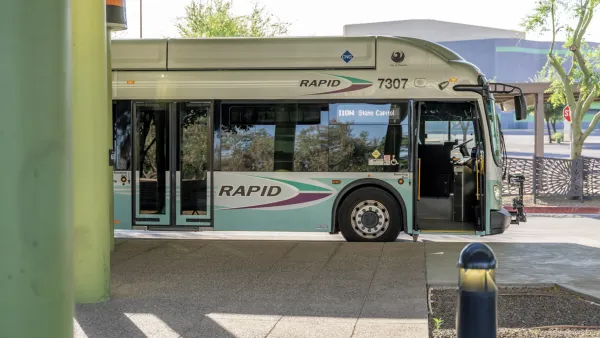
Phoenix announces new on-demand transit service, more frequent RAPID buses
Both new services will launch in October, and are part of Phoenix's Project Effective Access Solutions for Easing Congestion.
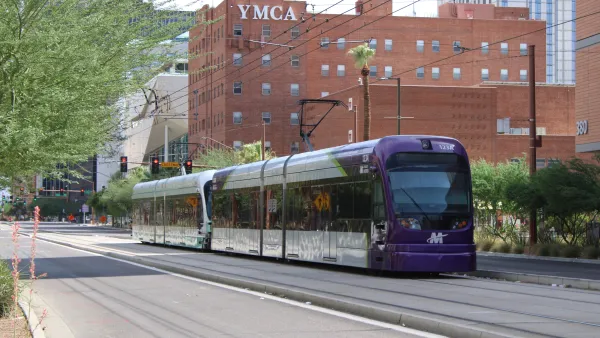
Phoenix cuts transit fares for low-income riders, tables fare-free days
The city council tabled discussions of four free transit days until it could do more research on the economic impact.
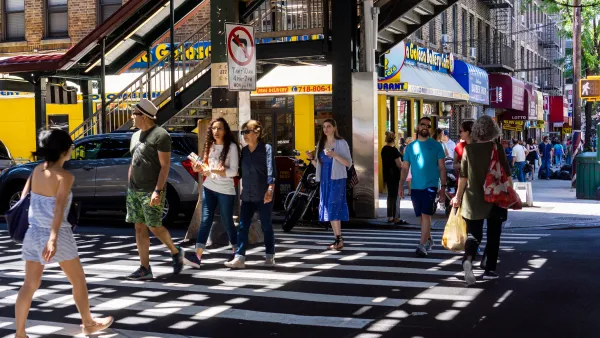
NYC needs 700,000 new homes to resolve housing crisis, report states
The report gave every neighborhood a non-binding development target.

Planetizen Federal Action Tracker
A weekly monitor of how Trump’s orders and actions are impacting planners and planning in America.

The state-sanctioned urbicide of Austin
People don’t kill cities. Freeways do.

US to reduce Colorado River water deliveries to Mexico
A new Colorado Treaty amendment reduces Mexico’s Colorado River water allocation by 250,000 acre feet.

Brightline West’s future may rely on $6 billion federal loan
The company has until Nov. 2 to make a $400 million equity investment into its proposed high-speed rail line.

LA Metro’s ultimatum: no extra buses for LA28 if federal funding isn’t imminently secured
If Metro does not provide additional buses, LA28 organizers will have to find a new way to manage Olympic traffic. LA28’s budget does not include a line item for transit.

Colorado’s Largest Data Center Could Rise Next to Homes — Without a Public Hearing
The proposed campus would consume 11 times the power of Denver International Airport; as it has across the country, opposition mounts.

FREE Course: Walkable City 1: Why Walkability?
After describing his path towards focusing on walkability as the essence of good planning, Jeff Speck marches through his five principal reasons for making more walkable places.
Reinventing Malls: Planning Alchemy—Turning Gray Fields Into Gold
The course focuses on the opportunities and imperatives that shape reinvention of mall sites.

Eagle County Government
Harvard University Graduate School of Design
Nashville Planning Department
The Architects Foundation
University of Cincinnati Online
The Pocatello Development Authority
The Urban Renewal Agency of the City of Pocatello
Journal of the American Planning Association