Will Doig believes that the choice of Tampa for the Republican National Convention is no coincidence: sprawling and practically devoid of public spaces or pedestrian facilities, it is a monument to not investing in the future.


Writing for Salon, Will Doig considers how Tampa's rejection of public investment in things like light rail and densification is emblematic of the GOP's world view.
"Tampa [suffers from] a toxic combination of hostility toward government, revenue and collectively used amenities. What's the matter with Tampa? The Republican conventioneers will get to see for themselves when they arrive. Except that some of them will be staying up to 90 miles away from the convention venue. "Tampa's reeeally spread out," the host of the Politico discussion observed to Mayor Buckhorn. That it is. And because of this, the city has chartered over 400 buses to move the convention visitors around while they're there. It's an inconvenient, makeshift, make-do solution - the kind that's necessary when you don't plan and don't invest - and a cautionary tale for America at large should a Romney-Ryan ticket reach the White House."
Read the full story: Tampa: America's hottest mess
Does Frank Lloyd Wright Set the Wrong Tone for the GOP Convention?
With their stage design influenced by the architectural icon, Christopher Hawthorne looks at the baggage the GOP inherits by riding Frank Lloyd Wright's caped coattails.
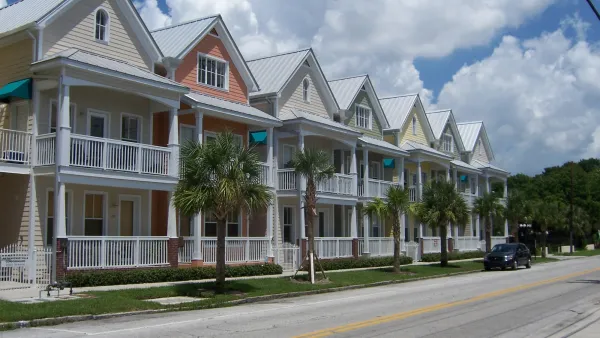
Tampa Awards 60% of Tampa Infill Housing Program Lots to Black Builders
The program encourages private-public partnerships that develop new, attainably priced housing on vacant and blighted lots.
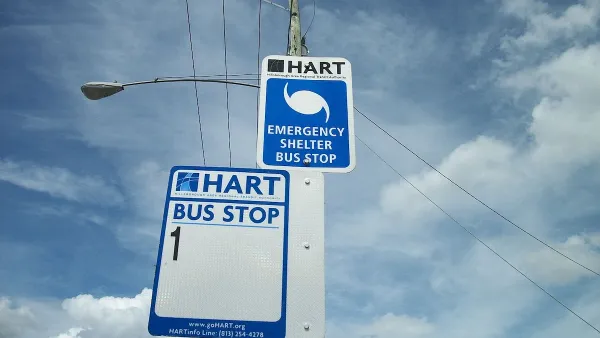
Popular Tampa Bus Route Going Fare-Free
The initiative, which starts on January 5, is funded by parking fees.

Planetizen Federal Action Tracker
A weekly monitor of how Trump’s orders and actions are impacting planners and planning in America.

California plans to bury El Niño’s downpour
If the state plays its cards right, it may be able to store a billion acre-feet of El Niño’s water in aquifers.

Desperate measures: Advocates weigh draining Lake Powell to fill Colorado River
Draining the reservoir could reduce evaporation losses by a couple hundred thousand acre-feet.

Seattle passes record-breaking transit services expansion
Proposition 1 will double the city’s transit tax to add 95,000 more bus trips and preserve 180,000 bus trips annually.

Post election, Texas is no longer Musk’s 'AI oasis'
Elon Musk dolled out $446 million on the 2026 midterms, the most ever spent by a non-canidate.

Chicago voters approve permanent festival grounds, penalty for vacant property owners
Currently, major summer and fall festivals take over public parks for weeks at a time, drawing criticism from nearby residents

FREE Course: Walkable City 1: Why Walkability?
After describing his path towards focusing on walkability as the essence of good planning, Jeff Speck marches through his five principal reasons for making more walkable places.
Reinventing Malls: Planning Alchemy—Turning Gray Fields Into Gold
The course focuses on the opportunities and imperatives that shape reinvention of mall sites.

City of Rosemead
Rutgers University, Edward J. Bloustein School of Planning and Public Policy
One Hundred Miles
Hunter College, City University of New York (CUNY)
The Architects Foundation
University of Cincinnati Online
City of Cambridge
Montrose County
The Pocatello Development Authority