Bill Hooper looks at the global effort to reinvent the airport as a place where people will actually want to spend time.


With an astonishing 5 billion travelers passing through the world's airports last year, owners and developers around the globe are seeking to turn hassled and harried peons into pampered customers. "Surely, there's more going on here than making nice-nice with
travelers," notes Hooper, an architect and Principal at Gensler. "'Aspirational' airports-those that have mastered the art of
distracting and ultimately luring travelers-have the potential to make
big money."
Examples abound.
"In Munich, the airport takes travelers to a precisely-honed Bavarian wunderland, a microcosm of Munich with an onsite brewery, indoor beer garden and slick Audi showroom. Changi Airport in Singapore has a Balinese-themed swimming pool among its long list of amenities. In Hong Kong, the airport entertains. Consider the outdoor nine-hole golf course and 350-seat IMAX theater that claims the largest projection screen in Hong Kong."
Read the full story: The Airport Of The Future Is About More Than Takeoff And Landing

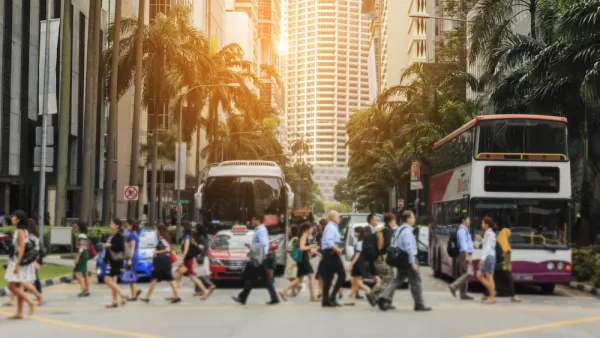
The Singapore Exception
Singapore, Taiwan, and Hong Kong were credited early in the pandemic with having successfully contained the coronavirus without resorting to lockdowns. However, Singapore lost its standing in that elite group. Crowding vs. density may explain why.

Coronavirus Success Stories
While the U.S. leads the world in COVID-19 infections and deaths, a small group of nations defied the odds and has shown remarkable success in containing the coronavirus. NPR investigates what they share in common, with a focus on New Zealand.

Asian, Australian Property Markets Begin to Cool
Markets for residential property income of East Asia's most expensive cities are slowing down. The U.S.-China trade war is one factor, along with local controls and a mainland Chinese economy applying the brakes.

Planetizen Federal Action Tracker
A weekly monitor of how Trump’s orders and actions are impacting planners and planning in America.

Amtrak, CN end decades-long dispute with eight-year agreement
The new operating agreement establishes an updated framework for the companies to work together, including processes to resolve disputes.

Northwest rail fans eager for Sept. 30 debut of Amtrak’s Airo fleet
Get ready for that new train smell and more seats. But they won’t go faster or run more frequently on the Cascades route in Washington and Oregon.

Brightline Florida files for bankruptcy
The transit company is over $5 billion in debt.

St. Louis Metro to test if single-car trains can reduce operating costs, maintain rider satisfaction
The pilot program will run from October to spring 2027, and begin with one single-car train operating on Metrolink’s Red and Blue lines.

Pennsylvania is building data centers in abandoned mines
Housing data centers in mines provides an alternative to destroying local forests and may spare residents from data centers’ noise and air pollution.

FREE Course: Walkable City 1: Why Walkability?
After describing his path towards focusing on walkability as the essence of good planning, Jeff Speck marches through his five principal reasons for making more walkable places.
Reinventing Malls: Planning Alchemy—Turning Gray Fields Into Gold
The course focuses on the opportunities and imperatives that shape reinvention of mall sites.

City of Thousand Oaks
City of Wisconsin Rapids
Harvard University Graduate School of Design
The Architects Foundation
University of Cincinnati Online
The Pocatello Development Authority
The Urban Renewal Agency of the City of Pocatello