Mashable's Brian Solis sits down for an interview with San Francisco's CIO, or "Chief Innovative Officer," to discuss the many ways the tech community is changing the way the city's government operates.


In an area famous for its technology start-ups and innovation, San Francisco's municipal government is looking to utilize the creative talent of the region's residents to improve its own operations. Brian Solis, of Mashable.com interviews Jay Nath, San Francisco's Chief Innovative Officer, to discuss the ways that technological innovation is being pursued and adopted.
Government is not commonly associated with the cutting edge of technology, especially within local government. San Francisco Mayor Ed Lee is looking to change that by bringing on people like Nath to bridge the technology and public sectors.
There are many reasons given for the new focus on technology. One, and perhaps the most blatant, are efficiency gains. For example, by using new systems of sensors, the city can now track its bus and parking systems to increase efficiency. Another benefit of incorporating technology Nath cites is the ability to bring greater transparency to government and civic participation. "We're no longer simply collecting taxes and providing a service," says Nath, "We're now saying lets work together and solve these grand challenges that we face...Hopefully it's a key signal for other cities that should be engaging in a very deep way with their community."
Read the full story: Startups Are Revamping Government in San Francisco

Evaluating the 2011 'Twitter Tax Break' Along San Francisco's Troubled Market Street
The 2011 "Twitter tax break" was controversial at the time, and remains so to this day. New offices and employees have filled the corridor of Market Street where the tax break is in effect, but massive challenges persist.
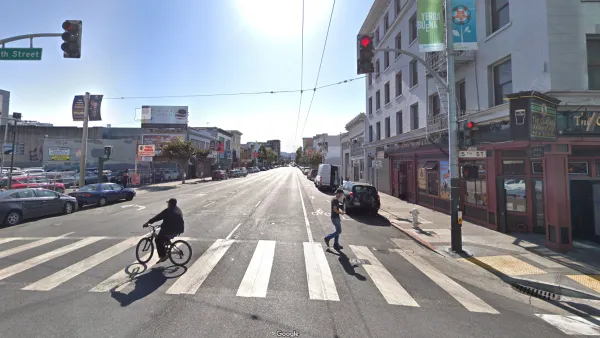
It Takes a Fatality to Remove On-Street Parking
On March 8, 30-year-old Tess Rothstein of Berkeley was riding a rented Ford GoBike in San Francisco's SoMa district when a car door suddenly opened, forcing her outside the narrow white line of the conventional bike lane into the path of a truck.

San Francisco Mayor Ed Lee Dies Suddenly at 65
San Francisco Mayor Ed Lee passed away of a heart attack early this morning. He was 65.

Planetizen Federal Action Tracker
A weekly monitor of how Trump’s orders and actions are impacting planners and planning in America.

California plans to bury El Niño’s downpour
If the state plays its cards right, it may be able to store a billion acre-feet of El Niño’s water in aquifers.

Desperate measures: Advocates weigh draining Lake Powell to fill Colorado River
Draining the reservoir could reduce evaporation losses by a couple hundred thousand acre-feet.

Chicago voters approve permanent festival grounds, penalty for vacant property owners
Currently, major summer and fall festivals take over public parks for weeks at a time, drawing criticism from nearby residents

NYC votes to cut outdoor dining red tape, speed up permitting
New York City also voted to allow the Department of Transportation to begin work on urgent projects before notifying elected officials.

California appears to reject Prop. 45
The proposition would have expanded the projects that qualify for a streamlined environmental review, effectively paring down the California Environmental Quality Act.

FREE Course: Walkable City 1: Why Walkability?
After describing his path towards focusing on walkability as the essence of good planning, Jeff Speck marches through his five principal reasons for making more walkable places.
Reinventing Malls: Planning Alchemy—Turning Gray Fields Into Gold
The course focuses on the opportunities and imperatives that shape reinvention of mall sites.

City of Rosemead
Rutgers University, Edward J. Bloustein School of Planning and Public Policy
One Hundred Miles
Hunter College, City University of New York (CUNY)
The Architects Foundation
University of Cincinnati Online
City of Cambridge
Montrose County
The Pocatello Development Authority