As Bus Rapid Transit (BRT) gains popularity, Annie Weinstock describes new standards for BRT, taking a lesson from some failing systems.


Cities looking to implement BRT could benefit from examining BRT failures as well as successes. The BRT Standard: Version 1.0, released earlier this year by the Institute for Transportation and Development Policy, employs a metric scoring system which is set for widespread distribution in 2013. Among the lowest scoring systems: Dehli, India's BRT and Virginia's Shirley Highway Busway.
Both systems are on the brink of failure as officials consider opening the underutilized bus lanes to car traffic. Weinstock identifies some of the missing pieces with these troubled BRT's:
- "No permanent stations and no off-board fare collection"
- "Frequency of buses was too low"
- "Stations, placed at intersections, leave insufficient space for free left turns (the equivalent of free right turns in the U.S.)"
- "No consistency in at-level boarding - which doesn't require passengers to step up to board and is a critical element to a smooth BRT experience."
Thanks to Jessica Brent
Read the full story: Do Bus Rapid Transit Right, And It Won’t Get Killed
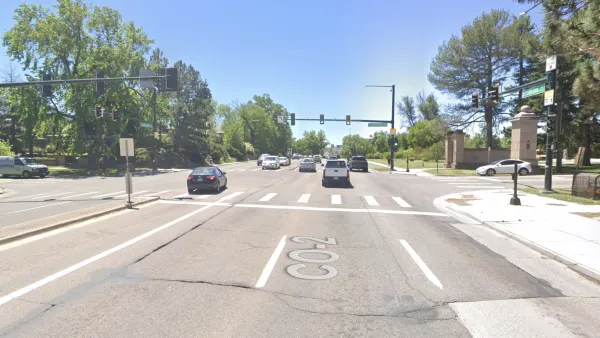
All sides of BRT debate unhappy with CDOT’s most recent move
The Colorado Department of Transportation is no longer considering center-running bus lanes for Colorado Boulevard.
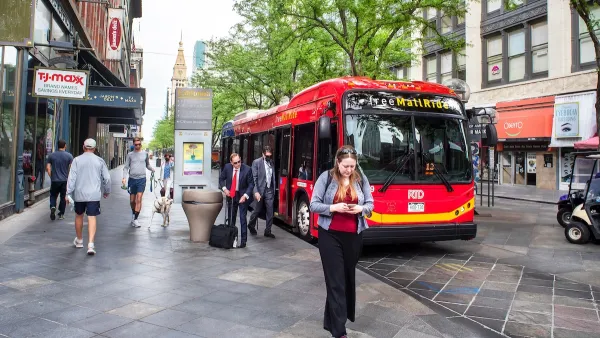
One of Denver’s busiest corridors to gain BRT
The project will span 18 miles and contain 74 bus rapid transit stations.

Experts Reject Florida Study That Killed St. Pete Bus Lane as ‘Incomplete,’ ‘Unfair’
A transit activist has filed a suit against FDOT, which used a a one-page study to justify removing a dedicated bus lane.

Planetizen Federal Action Tracker
A weekly monitor of how Trump’s orders and actions are impacting planners and planning in America.

Eastern Nebraska is running out of electricity
Data centers and electrification are straining eastern Nebraska’s grid, throttling economic development.

Study reveals best places in the U.S. for cycling, walking
New research from Streetlight Data examines bicycle and pedestrian miles per capita in the 100 largest U.S. cities by population.

DSA members accuse Mamdani of 'abandoning values' over housing redevelopment
New York City's mayor plans to replace about 2,000 units of public housing with private, mixed-income housing.

All sides of BRT debate unhappy with CDOT’s most recent move
The Colorado Department of Transportation is no longer considering center-running bus lanes for Colorado Boulevard.

Massachusetts bogs generate both power, and cranberries
Putting solar panels above farmland is one way Massachusetts is advancing toward its goal of net-zero carbon emissions by 2050.

FREE Course: Walkable City 1: Why Walkability?
After describing his path towards focusing on walkability as the essence of good planning, Jeff Speck marches through his five principal reasons for making more walkable places.
Reinventing Malls: Planning Alchemy—Turning Gray Fields Into Gold
The course focuses on the opportunities and imperatives that shape reinvention of mall sites.

City of Rosemead
Rutgers University, Edward J. Bloustein School of Planning and Public Policy
One Hundred Miles
University of Michigan School for Environment and Sustainability (SEAS)
Hunter College, City University of New York (CUNY)
The Architects Foundation
City of Cambridge
The Pocatello Development Authority
The Urban Renewal Agency of the City of Pocatello