America's fundamental levels of governance are changing, writes Anna Clark in Next American City, who uses examples from Detroit and Cleveland to ascertain what the stakes are when cities cede public sector work to third parties.


As cities around the U.S. have cut back on services, community development corporations, non-profits, and other neighborhood-level groups have been tasked with providing some of the very basic services that cities can no longer effectively nor efficiently provide. Mainstays of municipal governance like street resurfacing, graffiti removal, zoning and trash removal are being outsourced to these groups. Some, like University Circle, Inc. (UCI), in Cleveland's University Circle neighborhood, have been "providing parking, transportation, public safety programs and neighborhood landscaping in order to buoy the area's cultural and medical centers" since the 1950s.
But, some fear the lessening reliance on city services, and the lesser legal accountability that may accompany outsourcing to third-party groups. As Clark explains, "if CDCs and other non-profits are going to take on more and more public services, then they have a proportional amount of responsibility to be democratically structured. That means that both transparency and meaningful community accountability are crucial."
In this long read, Clark delves into the complex dance between cities and their partners in an emerging and evolving model of municipal governance.
Read the full story: Welcome to Your New Government

Learning loss and urban schools, part 2
Did test scores in progressive cities drop more post-COVID than test scores in moderate ones?
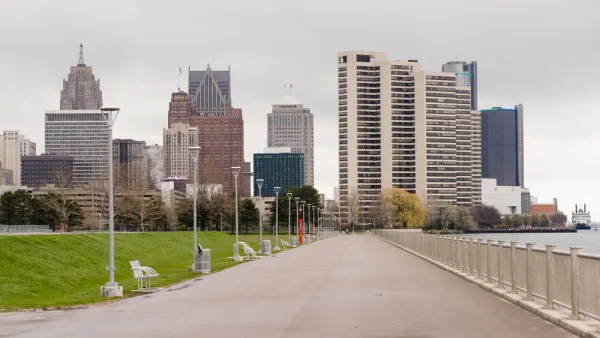
Shaping a 15-Minute City Vision for Detroit and Cleveland Using Data-Assisted Modeling
How master plans in the two cities hope to transform their historic, and historically underutilized, waterfronts.
Choice Neighborhood Planning Grants Announced for 5 U.S. Cities
A federal grant program designed to support holistic and socially-focused planning projects at the neighborhood level has announced the winners of its most recent round of competitive grant funding.

Washington state to charge fee to drivers with fuel-efficient cars
Revenue from the fee will go towards supporting the state’s highways.

Illinois considers spending $1 billion in taxpayer money on data center
A quantum computing campus and data center are currently under construction in Chicago.

Trump to blast ‘hydrocarbon highway’ through ‘world’s longest art gallery’
Environmental and historic preservation groups are suing to stop the project.

NYC, state sue feds over mixed-immigration-status housing assistance rule
The state’s lawsuit argues that the rule change violates the Administrative Procedure Act.

Michigan to turn neighborhood into virtual power plant
Residents will soon be able to divert their excess energy to the grid in exchange for compensation.

Data center, mining project swarm to long-awaited Alaska railroad line
The state-owned railroad approved final plans for the spur line this week; the project is expected to cost $311 million, mostly funded by the federal government

FREE Course: Walkable City 1: Why Walkability?
After describing his path towards focusing on walkability as the essence of good planning, Jeff Speck marches through his five principal reasons for making more walkable places.
Reinventing Malls: Planning Alchemy—Turning Gray Fields Into Gold
The course focuses on the opportunities and imperatives that shape reinvention of mall sites.

City of Charlotte
City of Rosemead
Rutgers University, Edward J. Bloustein School of Planning and Public Policy
University of Michigan School for Environment and Sustainability (SEAS)
Hunter College, City University of New York (CUNY)
The Architects Foundation
University District Partnership