Revisiting the metric he developed a decade ago in his groundbreaking book "The Rise of the Creative Class", Richard Florida ranks the American metros with the largest concentrations of creativity.


Totaling more than 40 million workers nationwide, from educators to architects, what Florida defines as the "creative class" is credited as, "a key driving force for economic development of post-industrial cities in the United States." A decade since its introduction, Florida has revisited his seminal text and, along with his Martin Prosperity Institute colleague Kevin Stolarick, has updated his ranking of America's metros with the largest concentrations of the creative class.
"Durham, North Carolina, where the creative class makes up 48.4 percent
of the workforce, tops the list. San Jose, California, is second,
followed by greater Washington, D.C.; Ithaca, New York; and Boulder,
Colorado." Noted absences from the top of the rankings include New York City (34th) and Los Angeles (60th).
According to Florida, "The geography of the creative class has become more uneven over the past
decade. Back when I did the initial metro rankings using 1999 data, the
highest share of the creative class was about 35 percent. Today, it's
pushing 50 percent....On the flip side, there is one metro where the
creative class makes up less than 20 percent of the workforce and 48
where it accounts for between 20 and 25 percent."
Read the full story: America's Leading Creative Class Metros

The Growing Urban Inequality Gap, Visualized
Inequality is growing faster in large metropolitan areas, according to a New York Times data visualization.
Study: Good Access to Transit Attracts Startups
Startups are increasingly abandoning the suburban office park to try their luck in denser urban cores. According to this study, good transit is one factor behind that trend. But it's not the only one.
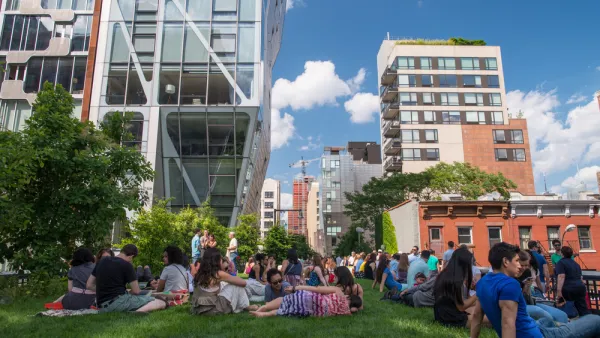
'The New Urban Crisis' and the High Line
A PBS NewsHour two-fer: an interview of urbanologist Richard Florida conducted in a walking tour of New York's famed High Line in the gentrifying West Chelsea neighborhood, a fitting backdrop for his new book, "The New Urban Crisis."

Planetizen Federal Action Tracker
A weekly monitor of how Trump’s orders and actions are impacting planners and planning in America.

‘Going backwards:’ Baltimore mayor, students rally against state's transit funding plan
Maryland's proposed six-year plan provides no funding for Baltimore’s BMORE bus program and reduces its road maintenance funding.

Detroit to transform waterfront with $2.2 billion investment
Developers will convert about 18 acres of unused parking lot space into civic spaces.

Data center developers are using lawsuits, cash offers to ‘overwhelm’ rural America
Newsrooms in five states worked together to uncover the tactics big tech developers use to buy land from reluctant communities.

U.S.-Iran war may have ‘devastating’ impact on cost to warm homes
Vermont and Maine residents may see a 76% increase in the cost of warming their homes this winter.

Senate bill would ‘overhaul’ environmental permitting laws
Under the proposed act, government agencies would also not be able to suspend or rescind permits after granting them.

FREE Course: Walkable City 1: Why Walkability?
After describing his path towards focusing on walkability as the essence of good planning, Jeff Speck marches through his five principal reasons for making more walkable places.
Reinventing Malls: Planning Alchemy—Turning Gray Fields Into Gold
The course focuses on the opportunities and imperatives that shape reinvention of mall sites.

One Hundred Miles
County of Mendocino
planning NEXT
The Architects Foundation
University of Cincinnati Online
Montrose County
Northern Illinois Transit Authority (NITA)
The Pocatello Development Authority