As new research data on cities pours in daily, interesting patterns emerge regarding income, green space and urban growth. Like people in their genetic make-up, are cities fundamentally all the same?


As The Economist reports, some interesting patterns behind the growth, land use and function of cities persists in even the world's most unique cities. The article states, "Regardless of size, their populations grow at the same average rate everywhere in the world. A city twice as large as its neighbour is likely to be 15% richer. The mix of green space and built-up areas tends to be equal everywhere."
Patterns like these have only emerged in recent years with the onslaught of new data, a shift in urban research and new methods of analysis. "Better technology has turned cities into fountains of data that confirm known regularities and reveal striking new patterns," states the article.
Some interesting statistics that have emerged regard the city's ability to create economies-of-scale, such as the fact that "big cities are thrifty versions of small ones," in that things like infrastructure per capita tends to decrease as cities grow, yet factors like income, savings and patents tend to grow.
Read the full story: The laws of the city

Choosing Ignorance is Stupid
People love statistics. They let us understanding the world beyond our own senses. USA Today publishes a daily Snapshot which presents a graph of random statistics. Sports talk and business analysis are dominated by statistics. We measure our progress, or lack thereof, and compare ourselves with others, based on statistics about our size, activities and accomplishments.

How Data-Driven Research Is Shaping Sustainable Urban Development
Explore how data-driven research is revolutionizing sustainable urban development, creating smarter, greener, and more resilient cities for the future.
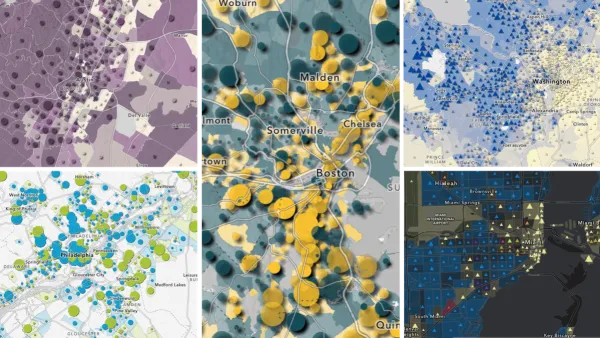
Explore US Demographics With the New ACS Atlas Collection
Esri's new ACS Atlas Collection offers interactive applications that visualize the latest U.S. demographic and socio-economic data, enabling users to explore over 175 curated web maps across various thematic areas.

Planetizen Federal Action Tracker
A weekly monitor of how Trump’s orders and actions are impacting planners and planning in America.

California plans to bury El Niño’s downpour
If the state plays its cards right, it may be able to store a billion acre-feet of El Niño’s water in aquifers.

Chicago breaks ground on $3 billion megadevelopment
The new neighborhood, titled Foundry Park, will one day host 3,700 residences.

Satanic Place Names
From streams and lakes to valleys and canyons, I mapped more than 1,000 places named after the Devil.

California High-Speed Rail Authority CEO resigns after $600,000 scandal
Under Ian Choudri, the authority used taxpayer dollars to fund first class flights and trips to nightclubs.

Want to study the Missouri River? Soon, you may need unanimous approval from 10 states
Legislation would require 10 governors’ permission to study or build projects moving water outside the basin.

FREE Course: Walkable City 1: Why Walkability?
After describing his path towards focusing on walkability as the essence of good planning, Jeff Speck marches through his five principal reasons for making more walkable places.
Reinventing Malls: Planning Alchemy—Turning Gray Fields Into Gold
The course focuses on the opportunities and imperatives that shape reinvention of mall sites.

City of Rosemead
Rutgers University, Edward J. Bloustein School of Planning and Public Policy
One Hundred Miles
Hunter College, City University of New York (CUNY)
The Architects Foundation
University of Cincinnati Online
City of Cambridge
Montrose County
The Pocatello Development Authority