Kim Severson follows the hipsters and food trucks to East Nashville to document a "down-on-its-luck side of town being brought to life one great plate of food at a time."


Nashville's resurgence resonates with Atlanta's and Charleston's before it, as "one of several midsize cities whose food sensibilities (and hipster quotient) are growing as people leave the dog-eat-dog cities on the coasts in search of more affordable, pleasant places to live and eat," writes Severson.
For a town long known for its musical culture, Severson tells the story of Nashville's recent rise through its food culture, and its "two totem foods: a meat-and-three lunch and an order of hot chicken," which "are a distillation of Tennessee's agrarian roots and Nashville's working class."
In Severson's culinary travels across the city, she witnesses the development of, "a different Nashville food scene, where the ethos of community, culinary adventure and democratized kitchen culture are uniting to define a new kind of Southern cooking that doesn't forgo its roots, but allows chefs to transcend them. As one chef told me, 'You don't have to cook pork if you don't want to.'"
Read the full story: Nashville’s Rising Stars: The Kitchen Is Their Studio
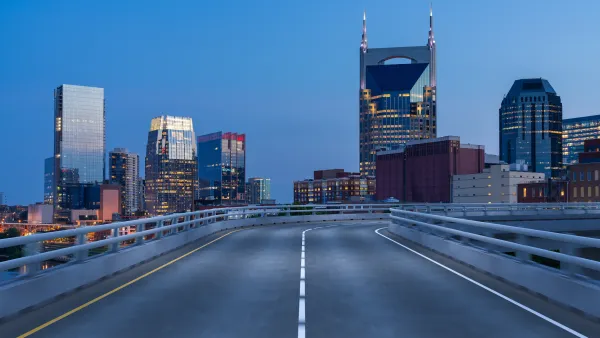
Tennessee advances $9.2 billion toll lane expansion project
The lanes will run along 26 miles of interstate, and toll prices will fluctuate depending on demand.
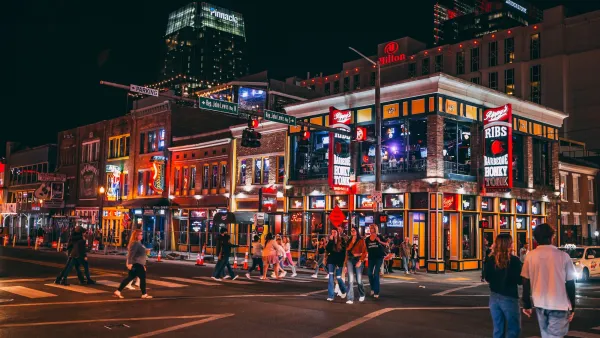
Tennessee DOT weighs making Nashville's Broadway car-free — sometimes
After a crash that killed one person and injured several others, state and city officials are in talks to consider options for closing the popular thoroughfare to cars during certain events.

Nashville installs concrete barriers to protect bike lanes
The new 'Toronto barriers' provide a physical buffer between cars and bike lanes.

Planetizen Federal Action Tracker
A weekly monitor of how Trump’s orders and actions are impacting planners and planning in America.

California plans to bury El Niño’s downpour
If the state plays its cards right, it may be able to store a billion acre-feet of El Niño’s water in aquifers.

Desperate measures: Advocates weigh draining Lake Powell to fill Colorado River
Draining the reservoir could reduce evaporation losses by a couple hundred thousand acre-feet.

Mamdani’s pied-à-terre tax survives legal challenge
A panel of judges found that the plaintiffs failed to demonstrate injury as a result of New York City's implementation of the tax.

Eastern Nebraska is running out of electricity
Data centers and electrification are straining eastern Nebraska’s grid, throttling economic development.

Seattle passes record-breaking transit services expansion
Proposition 1 will double the city’s transit tax to add 95,000 more bus trips and preserve 180,000 bus trips annually.

FREE Course: Walkable City 1: Why Walkability?
After describing his path towards focusing on walkability as the essence of good planning, Jeff Speck marches through his five principal reasons for making more walkable places.
Reinventing Malls: Planning Alchemy—Turning Gray Fields Into Gold
The course focuses on the opportunities and imperatives that shape reinvention of mall sites.

City of Rosemead
Rutgers University, Edward J. Bloustein School of Planning and Public Policy
One Hundred Miles
University of Michigan School for Environment and Sustainability (SEAS)
Hunter College, City University of New York (CUNY)
The Architects Foundation
City of Cambridge
Montrose County
The Pocatello Development Authority