For a city known for its storied history, but whose burgeoning creative culture has gone less noticed, a recent branding campaign was charged with the challenge of merging both identities.


Perhaps one of the most effective means of envisioning the future of a city is to integrate the rich culture of its past. Emily Badger reports on the city of Richmond, Virginia's effort to create a new identity for the historic city. Students at Virginia Commonwealth University's Brandcenter launched an "anti-campaign" re-branding program, giving voice to the multitudes of creative personalities of its residents and allowing them to shape their identity for themselves. Badger writes, "the whole idea was to both change Richmond's perception of itself, and to begin to in the process encourage more of the kind of creative output that would change perceptions of Richmond outside the city."
While other city branding efforts attempt to communicate a common zeitgeist, or spirit, the open source "RVA" program allows a multitude of Richmond's voices to represent their city. For the program, "the Brandcenter created an online generator that allows anyone to upload into the "RVA" logo images from the local music scene, or the river-rafting community, or the downtown streetscape--or a nearby battlefield. Running throughout all of these scenes is the idea that creativity takes many forms and that, in fact, Richmond's history has been defined by examples of it."
This re-branding program presents a process of history in the making, thus creating a new authenticity for future generations. The RVA YouTube video states, "Our past was based on creativity. Now our future depends on it." To forge ahead towards the future, the city poses a challenge to the question "Why?" by asking "Why not?" Through the collaboration of the various creative, social and working classes, the face of the city has come to resemble the people who live there, instead of the days of its past.
The Chamber of Commerce created a new organization around the RVA program called the ie* initiative which will have its first annual public startup competition June 21st to offer opportunities for enterprising entrepreneurs. The city of Richmond is well on its way to showcasing to the rest of the nation and the world its rich and vibrant culture, making this city one to watch.
Read the full story: Can the Old South Rebrand Itself? Richmond Tries, With a Dynamic New Logo

A 3D concrete printer may solve Virginia’s housing crisis
The printer is able to build concrete walls much faster than humans, and can do so directly at job sites.
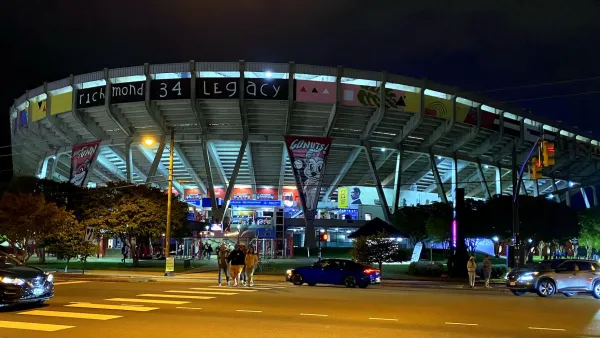
Richmond's new 'stadium district' will include hundreds of homes, offices, jobs
The city is planning for a neighborhood revival in the area around a new baseball stadium.

Phantom Tollbooths: Caltrans to Remove Bay Area Bridge Toll Booths Defunct Since 2020
The Richmond-San Rafael Bridge will be the first in the Bay Area to eliminate toll booths entirely in favor of open-road tolling using sensors.

Planetizen Federal Action Tracker
A weekly monitor of how Trump’s orders and actions are impacting planners and planning in America.

California plans to bury El Niño’s downpour
If the state plays its cards right, it may be able to store a billion acre-feet of El Niño’s water in aquifers.

Desperate measures: Advocates weigh draining Lake Powell to fill Colorado River
Draining the reservoir could reduce evaporation losses by a couple hundred thousand acre-feet.

Mamdani’s pied-à-terre tax survives legal challenge
A panel of judges found that the plaintiffs failed to demonstrate injury as a result of New York City's implementation of the tax.

Eastern Nebraska is running out of electricity
Data centers and electrification are straining eastern Nebraska’s grid, throttling economic development.

Seattle passes record-breaking transit services expansion
Proposition 1 will double the city’s transit tax to add 95,000 more bus trips and preserve 180,000 bus trips annually.

FREE Course: Walkable City 1: Why Walkability?
After describing his path towards focusing on walkability as the essence of good planning, Jeff Speck marches through his five principal reasons for making more walkable places.
Reinventing Malls: Planning Alchemy—Turning Gray Fields Into Gold
The course focuses on the opportunities and imperatives that shape reinvention of mall sites.

City of Rosemead
Rutgers University, Edward J. Bloustein School of Planning and Public Policy
One Hundred Miles
Hunter College, City University of New York (CUNY)
The Architects Foundation
University of Cincinnati Online
City of Cambridge
Montrose County
The Pocatello Development Authority