Christopher Hume surveys Toronto's "mid-rise crisis" and asks why the city has made it nearly impossible to build "the urban residential form par excellence."


Bemoaning the dearth of six- to eight-storey development, Hume blames overzealous NIMBYs and the "outdated and excessive parking requirements, emergency exit regulations and construction techniques that make the economics of mid-rise so tough."
Hume speaks with architect Roland Rom Colthoff, whose firm RAW Design has a number of mid-rise condos in the works, and more on the horizon, about the struggles of working with the city and the growing demand for the housing type.
"There's an explosion of interest in mid-rise right now," he [Colthoff] insists. "The price of condos makes these projects viable. Plus there's a cultural shift going on; there are new ideas about sociability in the city. Mid-rise buildings are not for investors but people who want to be part of a neighbourhood and what's happening."
Read the full story: Hume: Is Toronto having a mid-rise crisis?

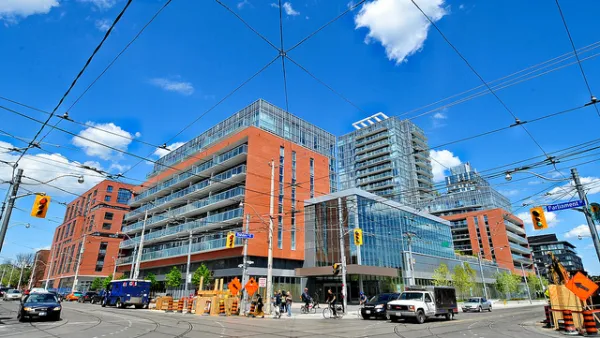
Condo Development Controversy Goes Viral in Toronto
The controversy over a proposed eight-story condo development in Toronto embroiled author Margaret Atwood this week.
Neighborhood Activists Mobilize Against Mid-Rise Developments in Toronto
There are neighborhoods where residents are concerned about new developments raising prices, and there are neighborhoods where residents are concerned about new developments lowering home values. Toronto is currently dealing with the latter.
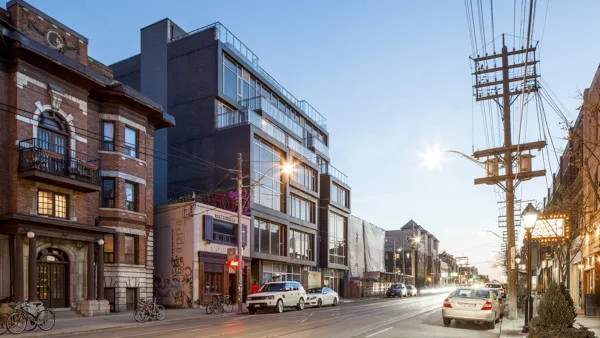
Mid-Rise: Density at a Human Scale
All growing cities must find ways to develop at appropriate, transit-supporting densities without overwhelming the surrounding context. The human-scaled, mid-rise building can be a solution—but achieving a good neighbourhood “fit” is not easy.

Planetizen Federal Action Tracker
A weekly monitor of how Trump’s orders and actions are impacting planners and planning in America.

California plans to bury El Niño’s downpour
If the state plays its cards right, it may be able to store a billion acre-feet of El Niño’s water in aquifers.

Chicago breaks ground on $3 billion megadevelopment
The new neighborhood, titled Foundry Park, will one day host 3,700 residences.

California High-Speed Rail Authority CEO resigns after $600,000 scandal
Under Ian Choudri, the authority used taxpayer dollars to fund first class flights and trips to nightclubs.

Want to study the Missouri River? Soon, you may need unanimous approval from 10 states
Legislation would require 10 governors’ permission to study or build projects moving water outside the basin.

Desperate measures: Advocates weigh draining Lake Powell to fill Colorado River
Draining the reservoir could reduce evaporation losses by a couple hundred thousand acre-feet.

FREE Course: Walkable City 1: Why Walkability?
After describing his path towards focusing on walkability as the essence of good planning, Jeff Speck marches through his five principal reasons for making more walkable places.
Reinventing Malls: Planning Alchemy—Turning Gray Fields Into Gold
The course focuses on the opportunities and imperatives that shape reinvention of mall sites.

City of Rosemead
Rutgers University, Edward J. Bloustein School of Planning and Public Policy
One Hundred Miles
Hunter College, City University of New York (CUNY)
The Architects Foundation
University of Cincinnati Online
City of Cambridge
Montrose County
The Pocatello Development Authority