Kaid Benfield looks at a groundbreaking new report compiled by Reconnecting America and the equity coalition Mile High Connects, that suggests how the expansion of Denver's transit system could reach traditionally underserved populations.


According to Benfield, the Denver Regional Equity Atlas, should serve as a nationwide precedent not just for its comprehensive approach to analyzing the coordination of transportation, housing, jobs, and access to important services, but also for its technological sophistication.
Coinciding with the Denver Regional Transportation District's "FasTracks" Program, "one of the country's most ambitious expansions of public transportation infrastructure and services," the report, co-written with the Piton Foundation, is intended to "inform the development of strategies to ensure that existing and expanding transit systems in the Metro Denver region provide greater access from affordable housing to jobs, good schools, health care and other essential services."
Read the full story: Impressive Denver study on equity & transit should become national model


Underwhelming FasTracks Plan Inspires Transit History Lesson in Denver
FasTracks, one of the most ambitious long-term transit plans in the U.S., has been underway for over 15 years. With the finish line in sight, some locals wonder how useful the new hub-and-spoke system (regional routes connecting to downtown) will be.
Using Data to Plan for Equity
Denver’s Equity Atlas is a pioneering effort between private, public, and non-profit interests to visualize a variety of statistics for the Denver metro area.
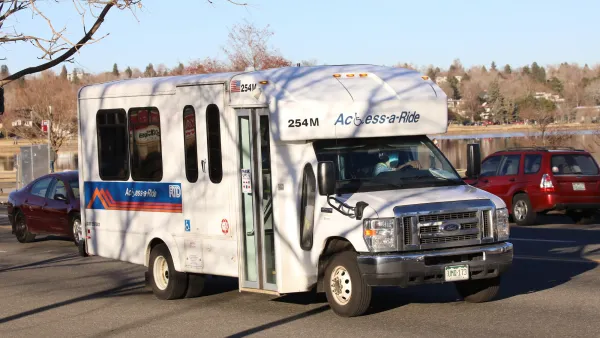
Denver Advocates Sue RTD for Charging People With Disabilities for On-demand Transit
The suit argues the agency is violating the rights of Americans with disabilities while lowering fares for other riders.

Planetizen Federal Action Tracker
A weekly monitor of how Trump’s orders and actions are impacting planners and planning in America.

California plans to bury El Niño’s downpour
If the state plays its cards right, it may be able to store a billion acre-feet of El Niño’s water in aquifers.

Chicago breaks ground on $3 billion megadevelopment
The new neighborhood, titled Foundry Park, will one day host 3,700 residences.

California High-Speed Rail Authority CEO resigns after $600,000 scandal
Under Ian Choudri, the authority used taxpayer dollars to fund first class flights and trips to nightclubs.

Want to study the Missouri River? Soon, you may need unanimous approval from 10 states
Legislation would require 10 governors’ permission to study or build projects moving water outside the basin.

Desperate measures: Advocates weigh draining Lake Powell to fill Colorado River
Draining the reservoir could reduce evaporation losses by a couple hundred thousand acre-feet.

FREE Course: Walkable City 1: Why Walkability?
After describing his path towards focusing on walkability as the essence of good planning, Jeff Speck marches through his five principal reasons for making more walkable places.
Reinventing Malls: Planning Alchemy—Turning Gray Fields Into Gold
The course focuses on the opportunities and imperatives that shape reinvention of mall sites.

City of Rosemead
Rutgers University, Edward J. Bloustein School of Planning and Public Policy
One Hundred Miles
Hunter College, City University of New York (CUNY)
The Architects Foundation
University of Cincinnati Online
City of Cambridge
Montrose County
The Pocatello Development Authority