After a cyclist fatally collided with an elderly pedestrian on a crowded Castro District crosswalk on March 29, city leaders are considering following the Bicycle Advisory Committee's recommendation to send cyclists who break traffic laws to class.


The death of the 71-year-old pedestrian has shed new light on the issue of cyclists breaking traffic laws, such as running red lights which is suspected in the tragic crash.
The Castro District fatality has received much attention in part because of the cyclist's on-line comments, made after the crash.
"The light turned yellow as I was approaching the intersection, but I was already way too committed to stop," the post stated.
"Bert Hill, chairman of The City's Bicycle Advisory Committee, said a program is being developed by his group, police and the District Attorney's Office to give first-time bicycling violators a dose of information instead of - or in addition to - a normal moving-violation citation. More details of the program, which could be rolled out by the fall, are still being determined, Hill said.
The announcement of the bicycling class proposal came during a news conference (April 10) called by Board of Supervisors President David Chiu."
The Examiner includes traffic collisions data, among them are the 899 pedestrian injuries in 2010 of which 96% were with motor vehicles.
Read the full story: S.F. might school scofflaw cyclists
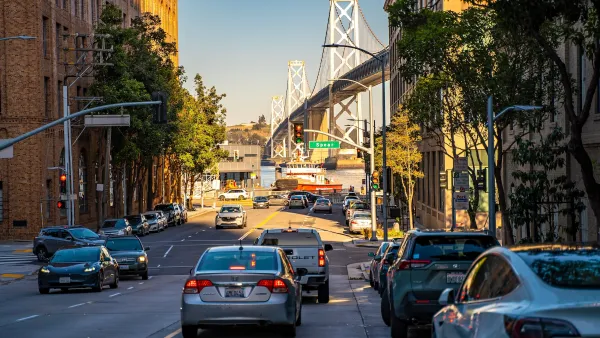
After San Francisco installed traffic cameras, speeding dropped by 80%
The city was allowed to install speed cameras as part of a five-year pilot program approved by California in 2023.
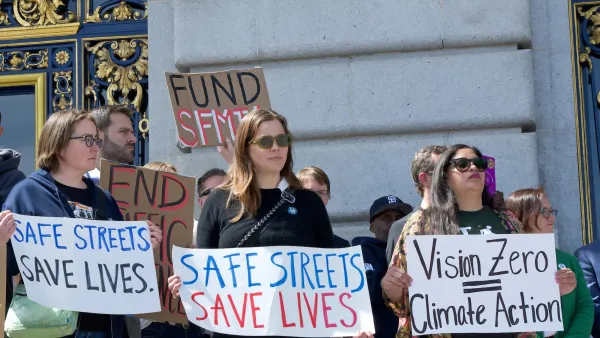
San Francisco Cut Traffic Deaths Almost in Half in 2025
The city credits its Vision Zero strategy and new traffic cameras for reducing the number of deaths and serious injuries on its roads.
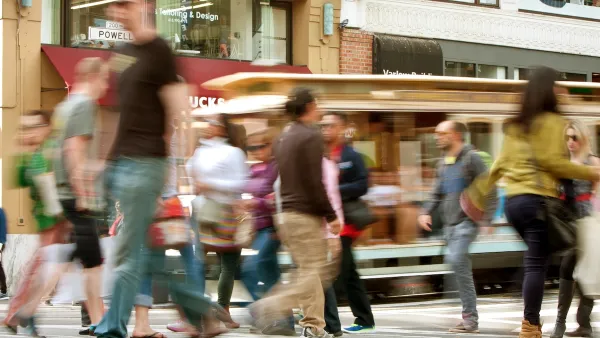
SF Street Safety Act Replaces Expired Vision Zero Plan
In 2025, 15 people have died in crashes in San Francisco, putting the city far behind its goal of eliminating traffic deaths by 2024.

Planetizen Federal Action Tracker
A weekly monitor of how Trump’s orders and actions are impacting planners and planning in America.

California plans to bury El Niño’s downpour
If the state plays its cards right, it may be able to store a billion acre-feet of El Niño’s water in aquifers.

Desperate measures: Advocates weigh draining Lake Powell to fill Colorado River
Draining the reservoir could reduce evaporation losses by a couple hundred thousand acre-feet.

Mamdani’s pied-à-terre tax survives legal challenge
A panel of judges found that the plaintiffs failed to demonstrate injury as a result of New York City's implementation of the tax.

Eastern Nebraska is running out of electricity
Data centers and electrification are straining eastern Nebraska’s grid, throttling economic development.

Seattle passes record-breaking transit services expansion
Proposition 1 will double the city’s transit tax to add 95,000 more bus trips and preserve 180,000 bus trips annually.

FREE Course: Walkable City 1: Why Walkability?
After describing his path towards focusing on walkability as the essence of good planning, Jeff Speck marches through his five principal reasons for making more walkable places.
Reinventing Malls: Planning Alchemy—Turning Gray Fields Into Gold
The course focuses on the opportunities and imperatives that shape reinvention of mall sites.

City of Rosemead
Rutgers University, Edward J. Bloustein School of Planning and Public Policy
One Hundred Miles
University of Michigan School for Environment and Sustainability (SEAS)
Hunter College, City University of New York (CUNY)
The Architects Foundation
City of Cambridge
Montrose County
The Pocatello Development Authority