Zak Stone reports on a campaign in Chattanooga, Tennessee to distill the city's artistic and entrepreneurial spirit into a font, and asks the question - can a font help a city make a comeback?


Earlier this week, we looked at campaigns to re-brand the city of Cleveland through sloganeering. Stone writes about an effort to re-brand the city of Chattanooga through purely graphic means, by developing a custom typeface to reflect the city's identity.
According to Stone, "The goal is to help the city and its businesses forge a distinct and cohesive identity through custom typeface, sending a visual message to the world that Chattanooga-a rapidly growing city in the midst of a creative renaissance-is 'more than just your average Southern town.'"
Led by brand consultant D.J. Trischler and typeface designer Jeremy Dooley, with collaborators including another typeface designer and a local historian, the result of the team's work is a new typeface they call Chatype. "Dooley calls the final style a 'geometric slab serif.' The 'slabs are inspired by the industrial past. The geometric aspect is to add a sense of futurism,' playing to the city's aspirations of becoming the 'Silicon Valley of the East Coast' with an economy fueled by technology and startups," writes Stone.
Chattanooga's public sector seems to be on-board with the project and the team hopes to see, "Chatype popping up on signage, business cards, emails, and websites published by the city government. In the long term, the team would love to see their typeface across street signs, sewer grades, police cars, and firetrucks."
Read the full story: Can a Font Help a City Make a Comeback?
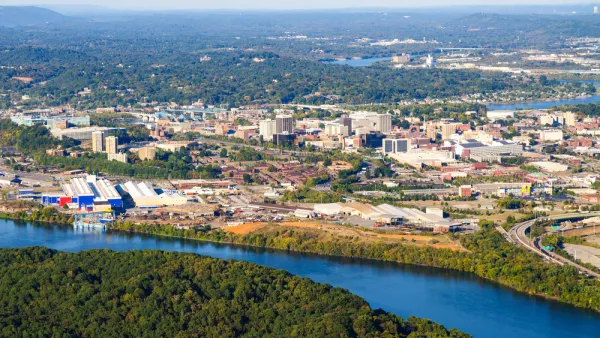
Friday Funny: Chattanooga Says it's 'Literally Perfect'
City branding got jokes.
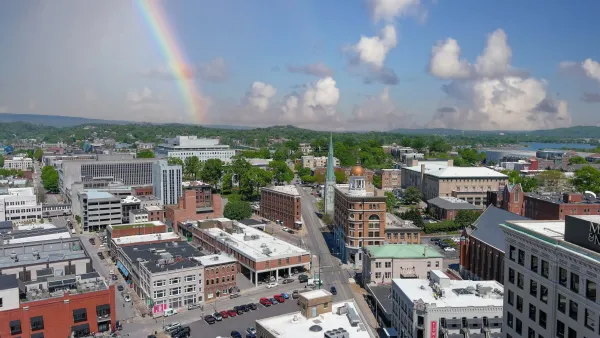
Chattanooga selects churches to build up to 400 affordable homes
Eight churches will move forward with plans to develop housing, from emergency shelter to single-family homes, on their properties.
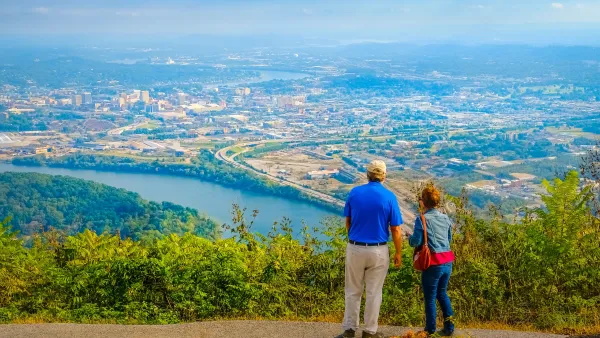
Chattanooga Earns North America’s First ‘National Park City’ Designation
The award recognizes cities that prioritize biodiversity and resident access to parks and green spaces.

Planetizen Federal Action Tracker
A weekly monitor of how Trump’s orders and actions are impacting planners and planning in America.

California plans to bury El Niño’s downpour
If the state plays its cards right, it may be able to store a billion acre-feet of El Niño’s water in aquifers.

Desperate measures: Advocates weigh draining Lake Powell to fill Colorado River
Draining the reservoir could reduce evaporation losses by a couple hundred thousand acre-feet.

Chicago voters approve permanent festival grounds, penalty for vacant property owners
Currently, major summer and fall festivals take over public parks for weeks at a time, drawing criticism from nearby residents

NYC votes to cut outdoor dining red tape, speed up permitting
New York City also voted to allow the Department of Transportation to begin work on urgent projects before notifying elected officials.

California appears to reject Prop. 45
The proposition would have expanded the projects that qualify for a streamlined environmental review, effectively paring down the California Environmental Quality Act.

FREE Course: Walkable City 1: Why Walkability?
After describing his path towards focusing on walkability as the essence of good planning, Jeff Speck marches through his five principal reasons for making more walkable places.
Reinventing Malls: Planning Alchemy—Turning Gray Fields Into Gold
The course focuses on the opportunities and imperatives that shape reinvention of mall sites.

City of Rosemead
Rutgers University, Edward J. Bloustein School of Planning and Public Policy
One Hundred Miles
Hunter College, City University of New York (CUNY)
The Architects Foundation
University of Cincinnati Online
City of Cambridge
Montrose County
The Pocatello Development Authority