Greenwich Village and Queens subway stations have had their trash bins removed for the past two weeks. This counterintuitive plan was initiated 3 months ago by officials due to an "epidemic of unsightliness and malodor," writes Michael Grynbaum.


In New York, the MTA have come up with a new plan that will help their garbage crews complete their daily rounds when collecting trash from the subways. According Grynbaum, the idea is "to reduce the load" for the crews who clear out 40 tons of trash from the system daily.
The PATH (Port Authority Trans-Hudson) Trains which service the area between New York City and New Jersey, had no bins since 2001 because of security concerns. Since the removal, it seems there is less trash, said Ron Marsico.
On the other hand, many are skeptical about the no-bin experiment. Bianca Thomas, who was waiting for a train pointed straight at the track. "Right there," she said, noting several plastic water bottles strewn by the third rail. "They'll more than likely toss it. Nobody wants to walk around with trash in their hand."
Read the full story: A Counterintuitive Trash Plan: Remove Bins in Subway Stations
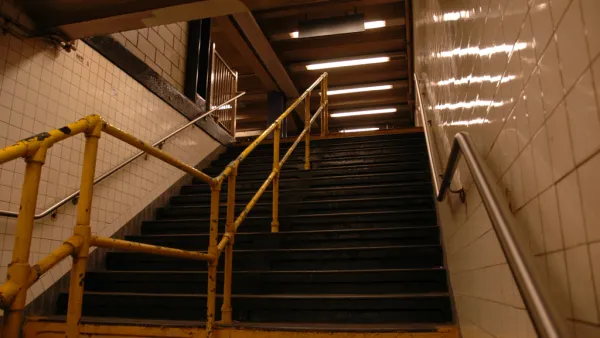
$5.5 Billion Plan for More Elevators in the N.Y.C. Subway
The city’s subway system is lagging in station accessibility, but the MTA has a plan to add elevators to 70 stations.
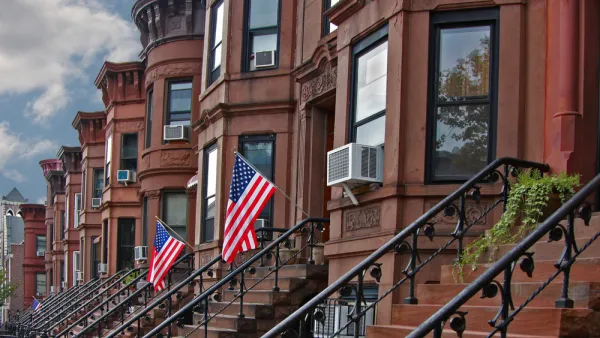
Controversial N.Y.C. Housing Program Under Fire
The Third Party Transfer program lets the city transfer ownership of delinquent properties, but it unfairly targets communities of color, say critics.
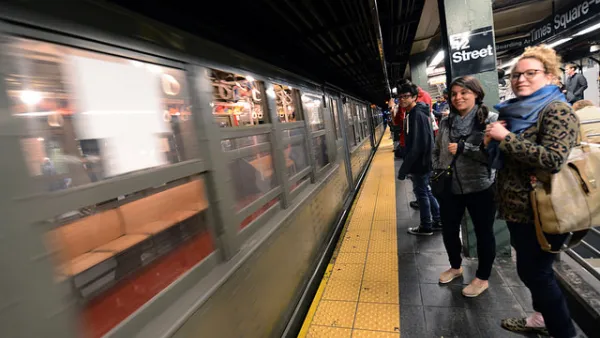
Speed Limits Increase for New York Trains
Brooklyn N and R trains can now move at faster top speeds, but only when there aren’t stopped trains ahead.

Planetizen Federal Action Tracker
A weekly monitor of how Trump’s orders and actions are impacting planners and planning in America.

California plans to bury El Niño’s downpour
If the state plays its cards right, it may be able to store a billion acre-feet of El Niño’s water in aquifers.

Desperate measures: Advocates weigh draining Lake Powell to fill Colorado River
Draining the reservoir could reduce evaporation losses by a couple hundred thousand acre-feet.

US buildings threatened, destroyed by fires set to triple by 2060
Researchers found a high fire risk for socioeconomically vulnerable neighborhoods in the American West.

LA residents may be allowed to paint their own crosswalks
Councilwoman Katy Yaroslavsky put out a motion instructing the Los Angeles Department of Public Transportation to study the feasibility of allowing volunteers to paint crosswalks.

Dallas moves to overhaul its zoning code
The city's zoning reform will allow more multi-family and mixed-use developments.

FREE Course: Walkable City 1: Why Walkability?
After describing his path towards focusing on walkability as the essence of good planning, Jeff Speck marches through his five principal reasons for making more walkable places.
Reinventing Malls: Planning Alchemy—Turning Gray Fields Into Gold
The course focuses on the opportunities and imperatives that shape reinvention of mall sites.

City of Rosemead
Rutgers University, Edward J. Bloustein School of Planning and Public Policy
One Hundred Miles
Hunter College, City University of New York (CUNY)
The Architects Foundation
University of Cincinnati Online
City of Cambridge
Montrose County
The Pocatello Development Authority