With the proliferation of new media planning practitioners have new ways to find out about the continuing work of planning faculty members who have retired. Not all of them blog of course, but the list below demonstrates some of the variety of these efforts.


With the proliferation of new media planning practitioners
have new ways to find out about the continuing work of planning faculty members
who have retired. Not all of them blog of course, but the list below
demonstrates some of the variety of these efforts.
- Emeritus Columbia Professor Peter
Marcuse, blogging at http://pmarcuse.wordpress.com/, can be relied upon for
provocative insights about current events. His recent postings explore
Occupy Wall Street but earlier blogs have investigated a number of his
other interests such as the foreclosure crisis, housing policy, and social
capital.
- Pierre Clavel, recently retired from
Cornell, has a blog and resource site at http://www.progressivecities.org/.
His blogging is in support of his wider project
of highlighting work on progressive cities. He has an
excellent bibliography at http://www.progressivecities.org/bibliography/.
- In the UK, Cliff Hague, an emeritus
professor at Heriot-Watt University in Edinburgh, blogs at http://cliffhague.planningresource.co.uk/,
a site affiliated with the Royal Town Planning Institute. Hague's "World
View" blog deals with topics of global concern such as innovation, UN
conferences, and regional resilience. Recent blogs feature cases in
Europe, Africa, and Australia.
- A slightly different take is the Sid
Grava blog, set up on his death in 2009: http://sigurdgrava.blogspot.com/2009/09/sigurd-grava-professor-emeritus-of.html.
It acts as a memorial for this long-time Columbia planning faculty member.
Of course there are a number of blogs by more senior but not
yet emeritus faculty, for example Larry Susskind at MIT (http://theconsensusbuildingapproach.blogspot.com/). These
are also well worth watching.

Building Bridges to the Future: Preparing the Next Generation of Planners
Discover the importance of preparing the next generation of urban planners to build a sustainable and thriving future.

Scraping Social Media to Analyze Public Engagement
Planners are increasingly using social media for public engagement. How can you analyze what people are saying? NodeXL is an easy to use free tool for scraping and analyzing social media. I use this tool to report from the APA National Conference.
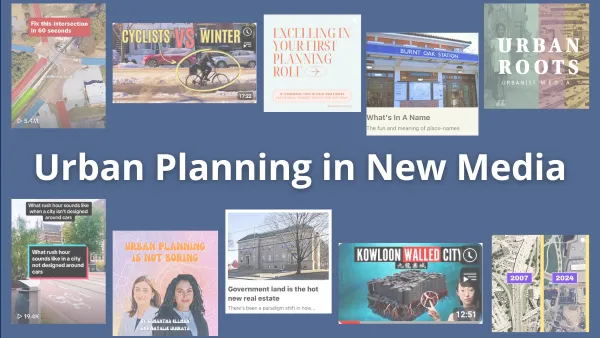
Urban Planning Creators You Should Know in 2024
Whether you’re a TikTok enthusiast or a Substack reader, you can find plenty of valuable and engaging urban planning content in the new media landscape.

Planetizen Federal Action Tracker
A weekly monitor of how Trump’s orders and actions are impacting planners and planning in America.

California plans to bury El Niño’s downpour
If the state plays its cards right, it may be able to store a billion acre-feet of El Niño’s water in aquifers.

Desperate measures: Advocates weigh draining Lake Powell to fill Colorado River
Draining the reservoir could reduce evaporation losses by a couple hundred thousand acre-feet.

Housing is the top priority of Seattle’s sole new councilmember
Jenks campaigned on building 1,000 new units of affordable housing.

New tax cuts may slash $1.5 billion in funding for Miami transit, public parks
Amendment 3 will save Miami-Dade homeowners $2,700 in 2028.

Arizona, Wisconsin, Pennsylvania hope to finally advance climate goals post-midterms
The three states have spent years under Republican or divided control.

FREE Course: Walkable City 1: Why Walkability?
After describing his path towards focusing on walkability as the essence of good planning, Jeff Speck marches through his five principal reasons for making more walkable places.
Reinventing Malls: Planning Alchemy—Turning Gray Fields Into Gold
The course focuses on the opportunities and imperatives that shape reinvention of mall sites.

City of Rosemead
Rutgers University, Edward J. Bloustein School of Planning and Public Policy
One Hundred Miles
University of Michigan School for Environment and Sustainability (SEAS)
Hunter College, City University of New York (CUNY)
The Architects Foundation
City of Cambridge
Montrose County
The Pocatello Development Authority

