Cities across California are proposing new stadium projects in hopes of luring football teams and economic growth as a result of their new megadevelopments.


From Oakland to L.A. to San Diego, cities are hoping to convince major sports teams and their crowds to come to town.
"The sports stuff is a catalyst for greater ends," summed up architect Morten Jensen, a principal at Bay Area firm JRDV, which developed a CRA-sponsored proposal for a stadium in Oakland that could not only host multiple teams but also help revitalize its immediate neighborhood through a slew of related development.
Such innovations are vital for a building type that is still notorious for shutting out its surroundings with large parking lots, hulking masses, and relatively little activity, pointed out Gabriel Metcalf, Executive Director of San Francisco Planning and Urban Research (SPUR). "The jury is still out on whether football stadiums are a net positive or negative for communities," noted Metcalf. "We need a reinvention of the form to create a way of knitting them back into the urban fabric.""
Read the full story: The Great Stadium Shuffle

Santa Clara Residents Back Stadium Spending
Residents in Santa Clara, California have approved a measure that would direct $937 million in funding towards the creation of a stadium intended to lure the San Francisco 49ers football team.
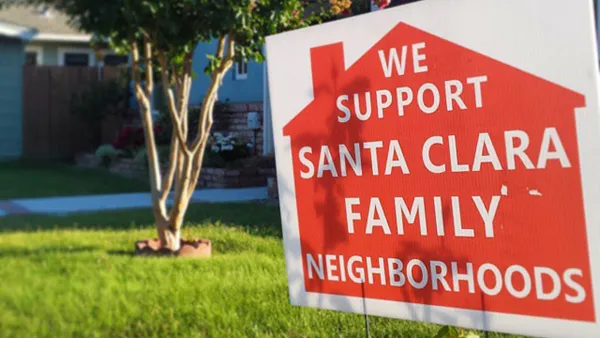
On Housing, Cities' Traditional Political Labels No Longer Apply
Historically liberal cities belie their supposed concern for human welfare by rejecting new development. Meanwhile, more conservative cities have seized the moment to become more progressive, innovative, and inclusive.
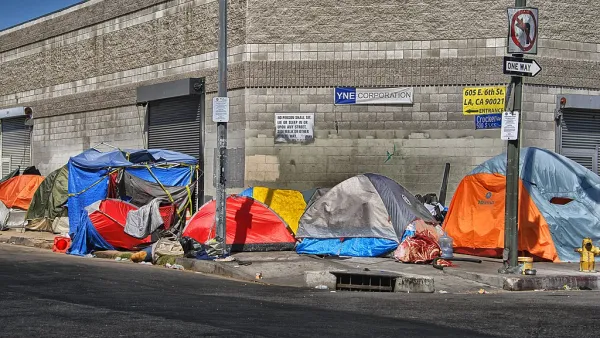
Homelessness Fuels a Backlash in California
The Golden State's ongoing homelessness crisis has residents on edge and is testing the limits of empathy in a state known for its liberal values.

Planetizen Federal Action Tracker
A weekly monitor of how Trump’s orders and actions are impacting planners and planning in America.

Amtrak, CN end decades-long dispute with eight-year agreement
The new operating agreement establishes an updated framework for the companies to work together, including processes to resolve disputes.

Judges permit Denver to divert 77,000 acre feet from the Colorado River for reservoir expansion
Overuse and climate change have caused the Colorado River’s water levels to plummet.

NYC DOT wants faster, more permanent street upgrades
The city is examining ways to build more concrete infrastructure without getting entangled in 'decades-long' projects.

'Something we’ve never seen before:' rising utility rates could strain city finances nationwide
Data centers, climate change and other factors have caused utility rates in the United States to increase by 38% since 2020.

Trump to overrule local leaders, lease millions of acres of America’s Pacific Island territories’ seafloors to mining companies
International law says that the Indigenous people of America’s territories have a right to prior and informed consent regarding projects that impact their countries.

FREE Course: Walkable City 1: Why Walkability?
After describing his path towards focusing on walkability as the essence of good planning, Jeff Speck marches through his five principal reasons for making more walkable places.
Reinventing Malls: Planning Alchemy—Turning Gray Fields Into Gold
The course focuses on the opportunities and imperatives that shape reinvention of mall sites.

Harvard University Graduate School of Design
KFH Group Inc.
Greater Baltimore Committee
The Architects Foundation
University of Cincinnati Online
The Pocatello Development Authority
The Urban Renewal Agency of the City of Pocatello