It is not uncommon for wealthy Chinese to spend seven figures - in cash - on real estate "as housing for children studying in New York."


Writing for The New York Times, Claire Wilson reports:
"Prices in New York are a draw, especially when compared with those in other cities where wealthy Asians might otherwise have invested. Luxury properties here are about $1,500 per square foot, while a comparable London flat is more than twice that, $3,600 per square foot. [...] Comparable real estate in Hong Kong costs $2,000 per square foot; in Monaco, $4,300. Current exchange rates also work in favor of Chinese buyers. China's rapid development means there is more money than ever to invest in the United States. And newly relaxed banking regulations in mainland China make it easier for investors to move money out of the country."
"Cash is the coin of the realm. Brokers estimate that 50 percent to 75 percent of transactions by Chinese in New York do not involve mortgages. Culturally, Asians are loan-averse, thinking that coming to the table with less than the asking price will reflect negatively on them."
"The majority of the sales fall at the lower end of the luxury spectrum, but in one case a parent spent $20 million on an apartment for a daughter at college in Manhattan."
Read the full story: A Second Home for Affluent Chinese
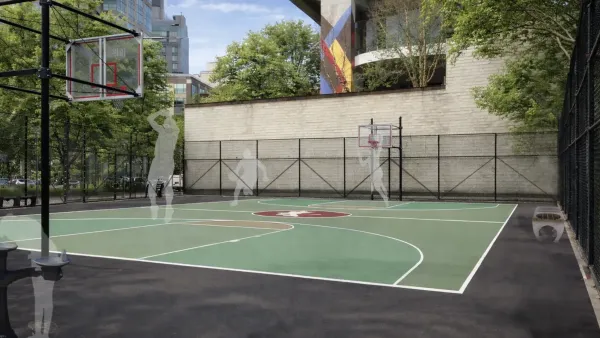
MTA gives itself 30 days to transform pit into basketball court
The site has been under construction since 2022; the city originally estimated it would finish the court in 2024.
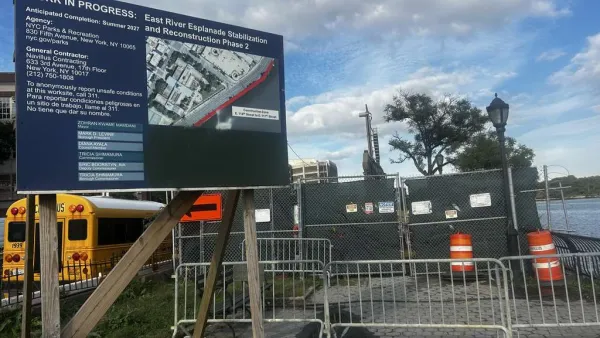
Ballooning costs delay NYC green space restoration after six years of planning
“There’s a stark inequity in how the city prioritizes infrastructure projects across different Manhattan neighborhoods," said Maria Kessler, executive director for Friends of the East River Esplanade. “Why is this neighborhood the last and unserved?”
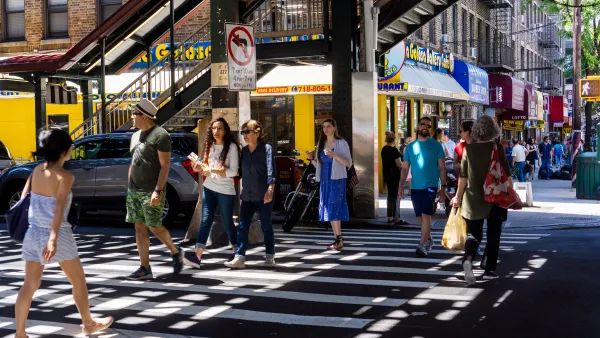
NYC needs 700,000 new homes to resolve housing crisis, report states
The report gave every neighborhood a non-binding development target.

Planetizen Federal Action Tracker
A weekly monitor of how Trump’s orders and actions are impacting planners and planning in America.

California plans to bury El Niño’s downpour
If the state plays its cards right, it may be able to store a billion acre-feet of El Niño’s water in aquifers.

Desperate measures: Advocates weigh draining Lake Powell to fill Colorado River
Draining the reservoir could reduce evaporation losses by a couple hundred thousand acre-feet.

Los Angeles just elected an urban planner as its mayor
Transportation analysts are optimistic that Raman will be more aggressive in addressing transit issues than Bass.

Mamdani’s pied-à-terre tax survives legal challenge
A panel of judges found that the plaintiffs failed to demonstrate injury as a result of New York City's implementation of the tax.

Eastern Nebraska is running out of electricity
Data centers and electrification are straining eastern Nebraska’s grid, throttling economic development.

FREE Course: Walkable City 1: Why Walkability?
After describing his path towards focusing on walkability as the essence of good planning, Jeff Speck marches through his five principal reasons for making more walkable places.
Reinventing Malls: Planning Alchemy—Turning Gray Fields Into Gold
The course focuses on the opportunities and imperatives that shape reinvention of mall sites.

City of Rosemead
Rutgers University, Edward J. Bloustein School of Planning and Public Policy
One Hundred Miles
University of Michigan School for Environment and Sustainability (SEAS)
Hunter College, City University of New York (CUNY)
The Architects Foundation
City of Cambridge
Montrose County
The Pocatello Development Authority